09 September 2009

THIEF PARADED NAKED


In a separate incident, a man suspected of stealing a car radio, CDs and wheel caps from a taxi, was hunted down and stripped naked by the taxi driver and his brother. The incident took place at Raglan Road at Fingo village.

Taxi driver, Bongani “Stunki” Gedze said they stripped him of his clothes to show residents that he was a thief.

“It worked because he told us where the wheel caps were and we went to his house and got them,” said Gedze.

Gedze stressed, that they never assaulted the suspect and also opened a case at the police station. Inspector Coetzer could not find records of the case. The suspect is still on the loose.

Coetzer said Grahamstown police were concerned about street law enforcement and warned that “vigilantism is viewed in a serious light and is illegal.”

I hope we can get the uncensored pics.

Claude Neal Lynching- Forced to eat his own penis


The Lynching of Claude Neal

Claude Neal was lynched in a lonely spot about four miles from Greenswood, Florida, scene of the recent crime. After Neal was taken from the jail at Brewton, Alabama (moved there supposedly for his protection), he was driven approximately 200 miles over highway 231 leading into Marianna and from there he was subjected to the most brutal and savage torture imaginable.

Neal was taken from the Brewton jail between one and two o'clock Friday morning, October 26. he was in the hands of the smaller lynching group composed of approximately 100 men from then until he was left in the road in front of the Cannidy home late that same night. Neal was tortured for ten or twelve hours. The original mob that took Neal from jail directed "all of the niceties of a twentieth century lynching . . . inflicted upon Neal." The word was passed all over Northeastern Florida and southeastern Alabama that there was to be a "lynching party to which all white people are invited."

A member of the lynching party described the lynching in all of its ghastliness, down tot he minutest detail:


After taking the nigger to the woods about four miles from Greenwood, they cut off his penis. He was made to eat it. They cut off his testicles and made him eat them and say he liked it. . . .
Then they sliced his sides and stomach with knives and every now and then somebody would cut off a finger or toe. Red hot irons were used on the nigger to burn him from top to bottom.

From time to time during the torture a rope was tied around Neal's neck and he was pulled up over a limb and held there until he almost choked to death. Then he was let down and the torture began all over again. After several hours of this unspeakable torture, they decided just to kill him.


Neal's body was tied to a rope on the rear of an automobile and dragged over the highway to the Cannidy home. Here a mob estimated to number somewhere between 3000 and 7000 people from eleven southern states was excitedly waiting his arrival. When the car which was dragging Neal's body came in front of the Cannidy home, a man who was riding the rear bumper cut the rope.

A woman came out of the Cannidy house and drove a butcher knife into his heart. Then the crowd came by and some kicked him and some drove their cars over him.


Men, women, and children were numbered in the vast throng that came to witness the lynching. It is reported from reliable sources that the little children, some of them mere tots, who lived in the Greenwood neighborhood, waited with sharpened sticks for the return of Neal's body and that when it rolled in the dust on the road that awful night these little children drove their weapons deep into the flesh of the dead man.

The body, which by this time was horribly mutilated, was taken to Marianna, a distance of ten or eleven miles, where it was hung to a tree on the northeast corner of the courthouse square. Pictures were taken of the mutilated form and hundreds of photographs were sold for fifty cents each. Scores of citizens viewed the body as it hung in the square. The body was perfectly nude until the early morning when someone had the decency to hang a burlap sack over the middle of the body. The body was cut down about eight-thirty Saturday morning, October 27, 1934.

Fingers and toes from Neal's body have been exhibited as souvenirs in Marianna where one man offered to divide the finger which he had with a friend as "a special favor." Another man has one of the fingers preserved in alcohol.

Henry Smith Lynching- Texas


Burned at the Stake: A Black Man Pays for a Town’s Outrage


From the eighteenth to the mid-nineteenth centuries, the term “lynching” did not have any racial implications. Targets included Tories, horse thieves, gamblers, and abolitionists. But starting in the 1880s, mob violence was increasingly directed at African Americans. Between 1882 and 1964, nearly five thousand people died from lynching, the majority African-American.


The 1890s witnessed the worst period of lynching in U.S. history. The grim statistical record almost certainly understates the story. Many lynchings were not recorded outside their immediate locality, and pure numbers do not convey the brutality of lynching. In early 1893, a white reporter, writing in the New York Sun, offered a grisly account of the burning at the stake in Paris, Texas, of a black man accused of molesting a white girl.As press accounts like this make clear, to witness a lynching—or even just glimpse its aftermath—could be a searing experience for those who were the most likely victims of the lynch mob—young African-American males. That, indeed, was the intention—the threat of lynching was a powerful mechanism for keeping black Southerners in line. In response to the rising tide of lynchings of African-Americans across the South during the 1890s, Memphis, Tennessee, newspaper editor Ida Wells-Barnett launched a national anti-lynching crusade.


--------------------------------------------------------------------------------

Paris, Texas, Feb. 1, 1893.—Henry Smith, the negro ravisher of 4-year-old Myrtle Vance, has expiated in part his awful crime by death at the stake. Ever since the perpetration of his awful crime this city and the entire surrounding country has been in a wild frenzy of excitement. When the news came last night that he had been captured at Hope, Ark., that he had been identified by B. B. Sturgeon, James T. Hicks, and many other of the Paris searching party, the city was wild with joy over the apprehension of the brute. Hundreds of people poured into the city from the adjoining country and the word passed from lip to lip that the punishment of the fiend should fit the crime—that death by fire was the penalty Smith should pay for the most atrocious murder and terrible outrage in Texas history. Curious and sympathizing alike, they came on train and wagons, on horse, and on foot to see if the frail mind of a man could think of a way to sufficiently punish the perpetrator of so terrible a crime. Whisky shops were closed, unruly mobs were dispersed, schools were dismissed by a proclamation from the mayor, and everything was done in a business-like manner.

About 2 o’clock Friday a mass meeting was called at the courthouse and captains appointed to search for the child. She was found mangled beyond recognition, covered with leaves and brush as above mentioned. As soon as it was learned upon the recovery of the body that the crime was so atrocious the whole town turned out in the chase. The railroads put up bulletins offering free transportation to all who would join in the search. Posses went in every direction, and not a stone was left unturned. Smith was tracked to Detroit on foot, where he jumped on a freight train and left for his old home in Hempstead County, Arkansas. To this county he was tracked and yesterday captured at Clow, a flag station on the Arkansas & Louisiana railway about twenty miles north of Hope. Upon being questioned the fiend denied everything, but upon being stripped for examination his undergarments were seen to be spattered with blood and a part of his shirt was torn off. He was kept under heavy guard at Hope last night, and later on confessed the crime.

This morning he was brought through Texarkana, where 5,000 people awaited the train. . . . At that place speeches were made by prominent Paris citizens, who asked that the prisoner be not molested by Texarkana people, but that the guard be allowed to deliver him up to the outraged and indignant citizens of Paris. Along the road the train gathered strength from the various towns, the people crowded upon the platforms and tops of coaches anxious to see the lynching and the negro who was soon to be delivered to an infuriated mob.

Arriving here at 12 o’clock the train was met by a surging mass of humanity 10,000 strong. The negro was placed upon a carnival float in mockery of a king upon his throne, and, followed by an immense crowd, was escorted through the city so that all might see the most inhuman monster known in current history. The line of march was up Main street to the square, around the square down Clarksville street to Church street, thence to the open prairies about 300 yards from the Texas & Pacific depot. Here Smith was placed upon a scaffold, six feet square and ten feet high, securely bound, within the view of all beholders. Here the victim was tortured for fifty minutes by red-hot iron brands thrust against his quivering body. Commencing at the feet the brands were placed against him inch by inch until they were thrust against the face. Then, being apparently dead, kerosene was poured upon him, cottonseed hulls placed beneath him and set on fire. In less time than it takes to relate it, the tortured man was wafted beyond the grave to another fire, hotter and more terrible than the one just experienced.

Curiosity seekers have carried away already all that was left of the memorable event, even to pieces of charcoal. The cause of the crime was that Henry Vance when a deputy policeman, in the course of his duty was called to arrest Henry Smith for being drunk and disorderly. The Negro was unruly, and Vance was forced to use his club. The Negro swore vengeance, and several times assaulted Vance. In his greed for revenge, last Thursday, he grabbed up the little girl and committed the crime. The father is prostrated with grief and the mother now lies at death’s door, but she has lived to see the slayer of her innocent babe suffer the most horrible death that could be conceived.

Words to describe the awful torture inflicted upon Smith cannot be found. The Negro, for a long time after starting on the journey to Paris, did not realize his plight. At last when he was told that he must die by slow torture he begged for protection. His agony was awful. He pleaded and writhed in bodily and mental pain. Scarcely had the train reached Paris than this torture commenced. His clothes were torn off piecemeal and scattered in the crowd, people catching the shreds and putting them away as mementos. The child’s father, her brother, and two uncles then gathered about the Negro as he lay fastened to the torture platform and thrust hot irons into his quivering flesh. It was horrible—the man dying by slow torture in the midst of smoke from his own burning flesh. Every groan from the fiend, every contortion of his body was cheered by the thickly packed crowd of 10,000 persons. The mass of beings 600 yards in diameter, the scaffold being the center. After burning the feet and legs, the hot irons—plenty of fresh ones being at hand—were rolled up and down Smith’s stomach, back, and arms. Then the eyes were burned out and irons were thrust down his throat.

The men of the Vance family have wreaked vengeance, the crowd piled all kinds of combustible stuff around the scaffold, poured oil on it and set it afire. The Negro rolled and tossed out of the mass, only to be pushed back by the people nearest him. He tossed out again, and was roped and pulled back. Hundreds of people turned away, but the vast crowd still looked calmly on. People were here from every part of this section. They came from Dallas, Fort Worth, Sherman, Denison, Bonham, Texarkana, Fort Smith, Ark., and a party of fifteen came from Hempstead County, Arkansas, where he was captured. Every train that came in was loaded to its utmost capacity, and there were demands at many points for special trains to bring the people here to see the unparalleled punishment for an unparalleled crime. When the news of the burning went over the country like wildfire, at every country town anvils boomed forth the announcement.

19 June 2009

Tarring and Feathering

Tar'd and Feather'd

Beginning in 1765 with colonial opposition to the Stamp Act and continuing through the Revolutionary War, a number of men were "tar'd and feather'd." The statements in this resource describe what was typically done to someone who underwent this punishment. These descriptions reveal that being tarred and feathered was rarely all that was done to the person. Often they were paraded about the town or treated with disrespect in other ways. Although rare, women were also subjected to this treatment. There is no record of the total number of Tories (i.e., Loyalists) or rebels who were treated in this way. Consequently, we cannot accurately estimate the number who were killed because of the tarring and feathering process or the acts subsequent to feathering.

"First strip a person naked, then heat the Tar until it is thin, and pour it upon the naked Flesh, or rub it over with a Tar Brush. . . . After which, sprinkle decently upon the Tar, whilst it is yet warm, as many Feathers as will stick to it. Then hold a lighted Candle to the Feathers, and try to set it all on Fire; if it will burn so much the better. But as the Experiment is often made in cold Weather, it will not then succeed--take also an Halter and put it round the Person's neck, and then cart him the Rounds [meaning around to certain places in the community and put on public display]."

At this point the person was usually taken about the streets of the town in a cart surrounded by shouting people. In some cases he might be placed in the stocks, hanged or beaten. If he survived, he was finally left on his own. Most who got this far were barely alive, exhausted and severely burned. The tar was extremely difficult to get off the badly burned skin, which often got infected. Those that survived could not be helped by anyone. Giving comfort or first aid to a survivor often would result in the helper being attacked.

Tarring and feathering was done not only by people who opposed the Crown and actions of Parliament. For example, in March 1775 Crown troops and Loyalists in Boston tarred and feathered a countryman. Holt's New York Journal, March 30, describes the events a reporter witnessed followed by his opinions of what took place:

"After stripping him naked and covering him with tar and feathers, they mounted him on a one-horse truck, and surrounding the truck with a guard of twenty soldiers with fixed bayonets, accompanied with all the drums and fifes of the regiment and a number of officers, negroes, and sailors, exhibited him as a spectacle through the principal streets of the town. They fixed a label on the man's back, on which was written AMERICAN LIBERTY, or A SPECIMEN OF DEMOCRACY; and to add insult they played Yankee Doodle

08 March 2009

INC crimes


IN THE STORY: "Three years after the shooting incident, on March 1992, four Iglesia Ni Cristo deacons butchered five students of the Polytechnic University of the Philippines (PUP) in the basement at the back of the INC chapel in Sta. Mesa, Manila. What escalated into a cold-blooded murder started only from a heated dispute during a basketball game. The corpses of the victims were later fished out of the murky waters of Pasig River. According to Supreme Court Reports Annotated (SCRA), in August 28, 2000 Chief Justice Hilario Davide, Jr. rendered judgment on the case “PEOPLE OF THE PHILIPPINES, plaintiff-appellee , vs. JUANITO ABELLA, DIOSDADO GRANADA, BENJAMIN DE GUZMAN, and EDGARDO VALENCIA, accused-appellants ,” where the four accused in these cases, who are deacons of the Iglesia Ni Cristo, were declared guilty beyond reasonable doubt on five (5) counts of MURDER. The record states “That on or about March 8, 1992, in the City of Manila, Philippines, the said accused, conspiring and confederating together with others whose true names, real identities and present whereabouts are still unknown and helping one another, did then and there wilfully, unlawfully and feloniously, with intent to kill and with treachery and evident premeditation, attack, assault and use personal violence upon one Marlon Ronquillo y Alepda [(Criminal Case No. 92-104529), one Felix Tamayo y Pascual (Criminal Case No. 92-104530), one Andres Lojero, Jr. y Pascual (Criminal Case No. 92-104531), one Joseph Ronquillo y Alepda [(Criminal Case No. 92-104532), one Erwin Lojero y Pascual (Criminal Case No. 92-104533)] by then and there hitting his head with guns, kicking him, tying his hands, [neck and private organ (additional allegation in Criminal Case No. 92-104531)] and thereafter throwing his body into the river thereby inflicting upon the latter mortal wounds which were the direct and immediate cause of his death thereafter.”

Postmortem examinations on the cadavers showed signs of torture. Marlon, Andres, and Joseph had contusions, ligature marks and hematoma; they were helplessly mauled while hands tied at their backs. Marlon had lacerated wounds and was killed due to a gunshot on the head. Andres’ genitals were cut off; Joseph had skull fracture; both died due to “asphyxia by strangulation; hemorrhage, intracranial, traumatic.” On the other hand, Erwin’s body showed abrasions and burns with blunt head injury, while Felix had abrasions on the left cheek and tie impressions on the wrists. The cause of their death was “asphyxia by drowning.” Murderers to this crime were defended by the Iglesia Ni Cristo camp up to the Supreme Court, a kind of support enjoyed by members of their church, regardless of the overwhelming evidences that prove the accused guilty of the crime." These are brutal crimes done by the members of this influential religious group. They claim to be of God but their deeds prove otherwise.

15 February 2009

14 Marines

The marines were not just beheaded, the arms and legs of the soldiers were chopped off; one of which the leg was never found and the terrorists even cut the penis of other soldiers. The MILF denied doing it.


BASILAN (Mindanao Examiner / 13 Jul) – Nagmatigas kahapon ang pamahalaan na dapat pagbayaran ng Moro Islamic Liberation Front (MILF) at Abu Sayyaf ang pagpatay sa 14 na sundalo sa lalawigan ng Basilan.
Sampu sa mga napatay ay pinugutan ng ulo at ang iba naman ay tinanggalan pa ng ari ng mga rebeldeng MILF at militanteng Abu Sayyaf sa labanan nanaganap nuong nakaraang Martes sa bayan ng Al-Barka.


Matatandaan na inamin ng rebeldeng Moro Islamic Liberation Front (MILF) na ang kanilang grupo ang nakasagupa ng mga tauhan ng Marines sa Bgy. Tipo-Tipo, Al-Barka, Basilan ngunit iginiit ni Mohager Iqbal, chief negotiator ng nasabing rebeldeng Muslim na iniwan ng mga rebelde ang lahat ng bangkay ng mga sundalo matapos ang sagupaan at wala silang kinalaman sa pagpugot at pagputol ng ari ng mga ito.


Dante Jimenez, founding chairman of the Volunteers Against Crimes and Corruption, had his hair shaved off on Sunday, to protest the gruesome death of Marine troopers, 10 of whom suffered beheading and mutilation. Jimenez, in an interview with radio dzBB, said he went to Fort Bonifacio and had his hair shaved off to unite with the families seeking justice for the 14 Marines who died in last week's clash with members of the Moro Islamic Liberation Front in Tipo-Tipo, Basilan. The Marines' remains lie in state at Fort Bonifacio in Taguig City. "Ako'y nakikiramay sa mga pamilya nitong mga pinatay na ating mga sundalo, mga Philippine Marines...Hindi lang 'yong pagpatay kundi 'yong dinismember pa sila, pinugutan ng ulo, pinugutan ng paa, pinugutan ng ari, pinugutan ng tenga (I condole with the families of the Marines. They were not just killed, but were dismembered, their heads, feet, private parts and ears were cut.)

********************************************************************

Dumadaloy ang pakikiramay sa Marines na napatay sa Basilan.
Ito ay dahil alamat na sa kasaysayan ng digmaan ang 1st Marine Brigade. Sila ang ang palaging isinasabak sa mga kalaban ng pamahalaan.
Kaya hindi na bago sa kanila ang mamatayan. Sabi nga nila, kasama ito sa trabaho.
Pero ang hindi nila matanggap ay ang kalapastanganang inabot ng 14 na Marines na tinambangan sa Basilan noong Martes.
Pugot, putol ang kamay o pati ang ari ng ilan sa mga bangkay na iniyakan ng kanilang mga mahal sa buhay.
Ang ulo ng mga napugutan

*****************************************************
The marine soldiers killed in action were: Staff Sergeants Noel F. Bautista and Bernard C. Abes; Sergeants Rey B. Callueng, Gerardo B. Licup, and Cayetano N. Simbajon; Private First Class officers Russel S. Panaga, Freddie G. Palma, Elizar S. Semeniano, Reuben S. Doronio Jr., Jhonard Alianza, Arjorin S. Eleazar, Emmanuel G. Beup, Emilio C. Lachica and Wilfredo G. Lamban.
***********************************************************
The Marines who survived an ambush in Basilan last week saw how some of their fallen comrades were beheaded by their attackers, officials said Sunday.
The attackers also took the soldiers’ valuables and personal belongings, including jewelry, money and mobile phones, officials said.
Of the 14 Marines killed in the clash, 10 were beheaded or had their bodies mutilated.
Marine commandant Maj. Gen. Nelson Allaga said the beheading of the wounded troops were cruel, sadistic and cowardly.
“That is sadism… but it’s even a cowardly act by standards… the wounded saw how the others were hacked,” Allaga told reporters.
The Marine spokesman, Lt. Col. Ariel Caculitan, said that aside from looting the dead soldiers, the attackers used the mobile phone of one the fallen Marines to send a message to his wife.
“We have beheaded your husband,” said Caculitan, quoting the text message.
Allaga added that the attackers also cut off the ears, hands and legs of some of the dead troops. Last week, there were reports that even the sex organs of some of the troopers were sliced off.
The outnumbered Marines fought on for nearly seven hours.
*************************************************************************
Dalawa sa 10 kagawad ng Philippine Marines na pinugutan sa Al Barka (Tipo-Tipo), Basilan noong Hulyo 10 ang na-karanas ng grabeng pagpapahirap o torture bago pinatay.
Ito ang lumabas sa post mortem examination ni Dr. Nilo Barandino ng Basilan General Hospital kung saan nakitaan ang mga nasabing sundalo ng sugat at pasa na palatandaan ng torture.
Pinutol din umano ang ari ng dalawang Marines na pinugutan sa gitna ng bakbakan sa naturang bayan habang nasa rescue operations ang tropa ng
pamahalaan sa dinukot na Italyanong paring si Fr. Giancarlo Bossi.

06 January 2009

Serbian soldier- Milomir Prodanovic

A Serb soldier who was captured by the Muslims, skewered on a spear and exhibited in front of a hotel. "He stayed alive for a few days," said a Serbian journalist. That set off wild rumors throughout Bosnian Serb-held territories.


Burned remains of Milomir Prodanovic, a Serb from Podravnje near Milici, Bosnia.(From: "The Suppressed Serbian Voice And The Free Press In America" By William Dorich, 1994 - pp 20, 22.)


23 September 2008

SI QUEY- Thailand's most infamous criminal


See Uey Sae Ung

The mummified corpse of See Uey Sae Ung (labeled as Si Quey on his display case and sometimes also referred to as Si-oui or Si Ouey depending on who is writing about him), the most notorious serial killer in Thai history is on display in the Songkran Niyomsane Museum of Forensic Medicine. A Chinese immigrant who moved to Thailand in 1944; See Uey suffocated and then ate the hearts and livers of over a half dozen male children. He apparently believed that the practice made him stronger, healthier, and by some accounts, immortal. He was captured and executed by hanging in the 1950s. After an autopsy, the cadaver was filled and covered with paraffin wax to preserve it. In recent years, the museum has added a film educating visitors about the story of See Uey. Over the years, See Uey has become a bogeyman for Thai children, as parents threaten misbehaving kids with a visit from his ghost. The case of See Uey Sae Ung was also adapted into the 2004 Thai thriller Zee-Oui.


11 August 2008

SAVAGES

Machetes and Elections


By NICHOLAS D. KRISTOF
Published: February 21, 2008

Until he was circumcised with a machete in front of a jeering mob and then dragged off to be beheaded, Robert Ochieng had been a symbol of modern, post-tribal harmony in Kenya.
A member of the Luo ethnic group, 16-year-old Robert had played and studied with members of another ethnic group, the Kikuyu. They were friends. And then Kenya erupted in rioting after a rigged election, and suddenly Luos were chasing and killing Kikuyus, and a mob of Kikuyus was running down Robert.

He claimed that he was Kikuyu as well, but the suspicious mob stripped him naked and noted that he was not circumcised, meaning that he could not be Kikuyu. That’s when his attackers held him down — smashing his arm when he tried to protect himself — and performed the grotesque surgery in the street to loud cheers from a huge throng.
The crowd shouted war cries and was preparing to decapitate Robert with a machete when the police arrived and rescued him. Doctors did some repair work and say he will recover physically, but as he sat in a church shelter for the displaced here in Kisumu in western Kenya, he seethed with hostility that may never heal.

“When I see Kikuyu shops that have been burned down,” he told me, “I feel good inside.” Never again will Robert be friendly with Kikuyu or have anything to do with them; he is now a symbol of the primeval tribal tensions that threaten Kenya’s future.

01 August 2008

Kidnapping- Double Murder

CHRISTOPHER NEWSOM-CHANNON CHRISTIAN- Double Murder

Hugh Christopher Newsom, Jr., 23, and Channon Gail Christian, 21, were a couple from Knoxville, Tennessee. According to a Tennessee grand jury, they were murdered and both were raped after being kidnapped early on the morning of January 7, 2007. Their vehicle had been carjacked. Five suspects have been arrested and charged in the case.The grand jury indicted four of the suspects on counts of murder, robbery, kidnapping, rape and theft, while one final suspect has already been convicted of federal charges as accessory after the fact to carjacking

According to news reports, Christian and Newsom had gone on a date at a local restaurant on Saturday, January 6, 2007, but did not return home. During their night out, the couple was "hijacked, bound and blindfolded and taken back to Lemaricus Devall 'Slim' Davidson's rented house on Chipman Street.

Christian's parents found her abandoned Toyota 4-Runner two blocks away from the Chipman Street house the following Monday with the help of her mobile phone provider. An envelope recovered from the vehicle yielded fingerprint evidence that led police to Lemaricus Davidson and 2316 Chipman Street. When police went to the address on Tuesday, January 9, they found the home unoccupied and Christian's body in a trash can in the kitchen.

Forensic evidence showed that Christian had also been raped vaginally, orally, and anally. One of the suspects, Vanessa Coleman, later told police that, "she witnessed Christian's mouth being cleaned with a bottle of some type of cleaner," in an attempt to remove DNA evidence. Forensic evidence showed significant trauma caused by "an object" to Christian's vagina, anus, and mouth, and that she had died slowly in the trash can, suffocating while wrapped in curtains, sheets, and several trash bags. There was also evidence of blunt trauma to her head leading to bruising of the brain in addition to bruises found on her neck, arm, back, and anal region. Coleman also said that she had seen "clothes that were stained with blood and smelled of gas being put in the washing machine at the house. Newsom was shot three times, "his body wrapped in a blanket, set afire and dumped alongside nearby railroad tracks. Evidence has also been presented that he had been anally raped


RAPE, MUTILATION AND MURDER:
A Horror Story Hidden from National Attention
James H. Lilley

On Saturday January 6, 2007 Hugh Christopher Newsom, age 23 and Channon Gail Christian, age 21, both students at the University of Tennessee went out on a date.
They were driving in Channon's Toyota 4-Runner when they were carjacked at gunpoint. Suddenly the crime turned far more savage than an armed car theft. Chris and Channon were kidnapped and driven to 2316 Chipman Street where they were forced into the home at gunpoint. While Channon was forced to watch, her boyfriend was raped prison style and then his penis was cut off. He was later driven to nearby railroad tracks where he was shot and set afire. But Channon's hell was just beginning. She was beaten; gang raped repeatedly in many ways, had one of her breasts cut off and bleach poured down her throat to destroy DNA evidence-all while she was still alive. To add to Channon's degradation the suspects took turns urinating on her. They too set her body afire, apparently inside the residence, but for some reason left her body there-in five separate trash bags

Jewish man- Kidnapped and horribly tortured


The Murder of Ilan Halimi
by NIDRA POLLER


PARIS--Two weeks ago a 23-year-old man initially identified as "Ilan" was found by a passerby stumbling in a field near the railroad tracks in the Essonne region south of Paris. Handcuffed, naked, with four-fifths of his body covered with bruises, stab wounds and serious burns, Ilan died in the ambulance on the way to the hospital.
Soon after, police provided more details. The victim had been kidnapped Jan. 20 and held for 24 days by a gang from the banlieues, the poor suburban projects that ring the French capital, who eluded capture while repeatedly contacting Ilan's family with ransom demands. The police suspect the group was involved in other kidnapping attempts in the past two months that used young women as bait. Several of the targeted men worked, as Ilan did, in the small cell phone shops along Boulevard Voltaire in the mixed 11th arrondissement of Paris. In another case, a suspicious father replaced his son for a meeting with a girl who claimed to be a singer, and fell into the hands of masked men who tried to capture him but ran away when someone called the police.
Throughout Ilan's disappearance, the police handled his case as a straightforward kidnap for ransom. The discovery of his body, bearing signs of barbaric torture over an extended period of time, raised serious doubts about this hypothesis. Later, a policeman admitted to the press that he and his colleagues were baffled by the gang's erratic behavior. Ransom demands went up to 400,000 euros, dropped to 100,000 euros one day, 5,000 euros another. The kidnappers called off several pickup arrangements, acting like amateurs, but were highly sophisticated in using untraceable emails and cell phones.

Yet one detail was consistently played down by the investigators and missing from the early media reporting on the killing. The victim, whose full name is Ilan Halimi, was Jewish. Most of the men targeted in other kidnapping attempts were Jewish. Most members of the gang who allegedly carried out the crime are Muslims, whose families come from the Maghreb or sub-Saharan Africa and live in the very sort of neighborhoods that went up in flames during three weeks of nationwide rioting last fall.
Jewish community leaders like Roger Cukierman, president of the Conseil Representatif des Institutions Juives de France, an umbrella group for the country's 600,000 Jews, cautioned against hasty conclusions and unreasonable panic. But French Jews have become sensitive to a well-documented rise in violent Muslim anti-Semitism over the past five years and saw anti-Semitism as the missing link in this senseless crime. After all, Ilan's family is simple and modest. Ruth Halimi, who is divorced from Ilan's father, works as a receptionist. Why else, people are asking, would Ilan be tortured so cruelly for so long? No other motive, aside from sheer hatred, is apparent.


After Ilan was found on Feb. 13, the pieces started to fall into place quickly. When the police put out a sketch of a blond woman who had tried to bait other young men in similar circumstances as Ilan Halimi's, Audrey Lorleach turned herself in. She led police to a housing project in Bagneux, a suburb in Hauts-de-Seine. Fifteen suspects in the Halimi murder, who call their gang the "Barbarians," were brought into custody. Youssouf Fofana, who refers to himself (in English) as the "Brain of the Barbarians," is the apparent ringleader. He is on the run and, investigators suspect, hiding in northern Ivory Coast, the birthplace of his parents. The girl who entrapped Ilan Halimi, who was also on the run, may be among the three people arrested in Aix-en-Provence this past week.
Ilan was held prisoner and abused in an apartment and later a utility room in the cellar in one of the project buildings. Both were lent to the gang by the concierge, who is also now in custody. Some in the gang were known delinquents. Mr. Fofana, who is 26, had served time for armed robbery. But another member was in on-the-job training in the IT service of a French TV station.
In initial statements to the press, Public Prosecutor Jean-Claude Marin and various police officials stuck to their hypothesis that money was the motive for the crime, not anti-Semitism. They noted that Ilan Halimi had been tortured as if the gang were following "a known scenario." Photos of Ilan, naked, with a sack on his head and a gun pointed at his temple were emailed to family members suggesting, according to the police, "scenes of torture at Abu Ghraib." As it turns out, the beheading of Daniel Pearl or Iraqi snuff films are the better comparison. An anonymous police detective quoted in this past Monday's edition of Liberation said: "It's simply that, for those criminals, Jew equals money."
Later that same day, investigating magistrate Corinne Goetzmann detained seven of the suspects on charges of kidnapping, sequestration, torture, acts of barbarism and premeditated murder in an organized gang. They will also be charged with targeting the victim on the basis of his religion, French for hate crime, which carries a stiffer penalty. Justice Minister Pascal Clement explained that the charge of anti-Semitism was based on the fact that one of the suspects had declared to the judge that they picked a Jew because Jews are supposed to be rich. But, according to reports in the French press, some of the suspects in police custody said that they tortured Ilan with particular cruelty simply because he was Jewish.
No longer able to deny or play down the racial motive, the investigation is entering a new phase. One of the most troubling aspects of this affair is the probable involvement of relatives and neighbors, beyond the immediate circle of the gang, who were told about the Jewish hostage and dropped in to participate in the torture.
Ilan's uncle Rafi Halimi told reporters that the gang phoned the family on several occasions and made them listen to the recitation of verses from the Koran, while Ilan's tortured screams could be heard in the background. The family has publicly criticized the police for deliberately ignoring the explicit anti-Semitic motives, which were repeatedly expressed and should have dictated an entirely different approach to the case from the start. Police searches have now revealed the presence of Islamist literature in the home of at least one of the gang members.

The highest echelons of the French government are now preoccupied with the murder of Ilan Halimi. Paris is well aware that the case threatens France's international reputation, but far more than that is at stake. Once again, as in the suburban riots of 2005, the country is forced to come face to face with the criminalized, alienated and racist Muslim youth and their adult enablers in its midst.
Prime Minister Dominique de Villepin declared, in a long speech delivered at the annual dinner of the CRIF, that this heinous crime was anti-Semitic, and that anti-Semitism is not acceptable in France. He promised that the perpetrators would be captured and punished. Two French policemen were sent to the Ivory Coast with an international warrant to arrest Mr. Fofana who flew there on a one-way ticket on Feb. 15, the day that his photo appeared in Le Figaro. A delegation of the CRIF and members of the Halimi family this past Tuesday met with Interior Minister Nicolas Sarkozy.
The murder of Ilan Halimi invites comparison with the November 2003 killing of a Jewish disc jockey, Sebastien Selam. His Muslim neighbor, Adel, slit his throat, nearly decapitating him, and gouged out his eyes with a carving fork in his building's underground parking garage. Adel came upstairs with bloodied hands and told his mother, "I killed my Jew, I will go to paradise." In the two years before his murder, the Selam family was repeatedly harassed for being Jewish. The Selam case has not been opened by the magistrate. The murderer, who admits his guilt, was placed in a psychiatric hospital, and may be released soon.
The initial response to the kidnapping of Ilan Halimi suggested a comparably selective ignorance. But many things have changed in French society in the past two years. Then, faced with the new tide of anti-Semitism, the Jewish community was left alone with its distress and at times even accused of being justifiably targeted because of its support for Israel. Today the government has apparently decided that the barbarous hatred unleashed against one Jewish man is a threat to all of France.

Timeline of the crime

According to press reports based on information from French criminal investigation authorities, as of 25 February 2006 the crime is believed to have happened as follows:

On 21 January, Halimi, aged 23, was lured by an attractive 17-year-old French-Iranian girl to an apartment block in the Parisian banlieues (suburbs, which are often associated with the poor).

There Halimi was overwhelmed by a youth gang and kept prisoner for twenty-four days. During that time, his kidnappers tortured him by stabbing him with knives, burning his face and body with cigarattes and beating him in order to try to extract a ransom of initially EUR 450,000 from his family. As the days wore on, his captors turned increasingly cruel, stripping off his clothes and beating, scratching and cutting him. A burning cigarette was pressed into his forehead. His kidnappers finally poured flammable liquid on him and set him on fire. Reportedly, neighbors came by to watch and to even participate in the torture but no one called the authorities.


On 13 February, Halimi was found naked, tied and handcuffed to a tree near a railroad track in the Parisian suburbs, with burns from acid and flammable liquid covering 80% of his body (possibly to destroy evidence of his captors' DNA), with multiple stab wounds, as well as with one severed ear and toe. On the way to the hospital, he died from his wounds.

In the subsequent days, French police arrested 21 persons in connection with the crime, including the woman used as bait. The alleged leader of the gang, Youssouf Fofana, fled to his parents' homeland of Ivory Coast, where he was arrested on 23 February. Fofana was extradited back to France on 4 March 2006.

Other sources from the net

Torture and Death of Jew Deepen Fears in France

By Craig S. Smith

BAGNEUX, France, March 3

Two strips of red-and-white police tape bar the entrance to the low-ceilinged pump room where a young Jewish man, Ilan Halimi, spent the last weeks of his life, tormented and tortured by his captors and eventually splashed with acid in an attempt to erase any traces of their DNA.

The floor of the concrete room, in the cellar of 4, rue Serge-Prokofiev, is bare except for a few packets of rat poison, a slowly drying wet mark and a dozen small circles drawn and numbered in white chalk, presumably marking the spots where the police retrieved evidence of Mr. Halimi's ordeal.

Mr. Halimi, 23, died Feb. 13, shortly after he was found near a train station 15 miles away by passers-by, after crawling out of the wooded area where he was dumped. He was naked and bleeding from at least four stab wounds to his throat, his hands bound and adhesive tape covering his mouth and eyes. According to the initial autopsy report, burns, apparently from the acid, covered 60 percent of his body.

"I knew they had someone down there," said a young French-Arab man, loitering in the doorway of a building adjacent to the one where Mr. Halimi was held. He claimed to live upstairs from the makeshift dungeon but would not give his name or say whether he knew then that the man was a Jew. "I didn't know they were torturing him," he said. "Otherwise, I would have called the police."But it is clear that plenty of people did know, both that Mr. Halimi was being tortured and that he was Jewish. The police, according to lawyers with access to the investigation files, think at least 20 people participated in his abduction and the subsequent, amateurish negotiations for ransom. His captors told his family that if they did not have the money, they should "go and get it from your synagogue," and later contacted a rabbi, telling him, "We have a Jew."

The horrifying death has stunned France, which has Europe's largest Muslim and largest Jewish populations. Last weekend, tens of thousands of people marched against racism and anti-Semitism in Paris, joined by the interior minister, Nicholas Sarkozy, and smaller marches took place in several other French cities, including Marseille.In the wake of the riots that broke out in the immigrant-heavy Paris suburbs last fall, the case seems to embody the social problems of immigration, race and class that France has been facing with so much uncertainty. The emerging details raise deep fears of virulent anti-Semitism within the hardening underclass, and point to the decaying social fabric in which that underclass lives.

Those that the police say kidnapped and killed Mr. Halimi called themselves the Barbarians, and included people of different backgrounds: the children of blacks from sub-Saharan Africa and the Caribbean, of Arabs from North Africa, of at least one Persian from Iran, and of whites from Portugal and France.The gang's leader was a tall, charismatic young man named Youssouf Fofana, 25, one of five children born in Paris to at least nominally Muslim immigrants from Ivory Coast. When he was a teenager, the family moved to the bleak neighborhood of 12-story concrete apartment blocks where Mr. Halimi was held.Trouble started early. He studied plumbing at a local vocational school but by the age of 16 had already begun a series of run-ins with the police, eventually racking up 13 arrests for everything from theft to fencing stolen goods. In 1999, at the age of 19, he stole a car, beating the Portuguese owner who tried to intervene. He was arrested and sentenced to his only jail term, serving two years in prisons in Nanterre and Fleury-Mérogis, neither far from Paris.He returned to his mother's apartment and used his prison credentials to assume the role of senior tough among younger, idle men and women, people in the neighborhood say. Lawyers familiar with the case suggest that this is when the seeds of the Barbarians were sown.By 2004, the police say, he tried extortion, aiming at prominent French Jews. When that failed, the gang apparently turned to kidnapping, using young women as bait.The Barbarians are thought to have been behind six attempted abductions, four of Jewish men, before succeeding with Mr. Halimi.In a case in early January, a woman tried repeatedly to get a Jewish music producer to meet her on the outskirts of Paris, finally managing instead to persuade his father to come to a suburban parking lot, on the pretext that she had music CD's that belonged to his son. Several men met the father instead, beating him senseless when he resisted their attempt to force him into their car.

Mike Akiba worked with Mr. Halimi at Voltaire Phone in Paris, one of a dozen tiny Jewish-owned cellular telephone shops along Boulevard Voltaire in the 11th Arrondissement. He said Mr. Halimi was alone in the store when a 17-year-old French-Iranian girl came in and flirted with him. Mr. Akiba said she might have thought Mr. Halimi, a handsome man with piercing brown eyes, was the owner.Mr. Halimi told Mr. Akiba about her the next day and said he had agreed to meet her that Friday night near Porte d'Orleans, a neighborhood on Paris's southern edge. Mr. Akiba last saw him about 10:30 p.m. on Friday, Jan. 20, as he drove from Boulevard Voltaire in his Champagne-colored Renault Twingo.Mr. Halimi apparently met the woman as planned, then drove her to Sceaux, a suburb near Bagneux, where his captors must have grabbed him. His car was later found abandoned in a parking lot there.Mr. Akiba said the investigating police officers discovered the gang had tried the same tactic on several men in the other phone shops.

Mr. Halimi was taken to the Pierre-Plate housing project in Bagneux, and initially held in an empty third-floor apartment at 1, rue Serge-Prokofiev, with the help of the building's superintendent, according to the lawyers who have seen the investigative files. The gang covered his eyes and mouth with tape, leaving only a hole for a straw.The Halimi family's first contact with the kidnappers was the night of Saturday, Jan. 21, when a gang member called Mr. Halimi's girlfriend and instructed her to log on to a Hotmail e-mail account. That began a series of agonizingly disjointed communications from Mr. Halimi's abductors that included hundreds of phone calls and e-mail messages, and ransom demands that started at $500,000 and dropped to $5,000, said the family's lawyer, Francis Szpiner.

After a few days, the gang moved their captive to the concrete basement room beneath a section of the building a few doors down. They shaved his head and sliced his cheek with a knife, photographed him with blood running down his face, and e-mailed the picture to his family.As the days wore on, his captors turned increasingly cruel, stripping off his clothes and beating, scratching and cutting him. A burning cigarette was pressed into his forehead.The family was instructed to send a ransom to Ivory Coast, via Western Union, and Mr. Fofana traveled to that country at least once in early February. According to reports after his eventual arrest, it was after the ransom failed to arrive that the torture of Mr. Halimi began in earnest.The police did not yet know the identities of the gang members but were close on their heels. Around Feb. 10, Mr. Fofana briefly visited an Internet cafe on the Rue de la Fidélité in the 10th Arrondissement, wearing a cap and a scarf that covered his mouth and nose. "I don't even think he took his gloves off," the manager said Friday. Just 15 minutes later, he said, police officers arrived looking for a black man, a computer-generated sketch in hand. They lifted fingerprints from the keyboard Mr. Fofana had used and confiscated the computer's hard drive and the 5-euro note he had paid with.On the evening of Feb. 13, Mr. Halimi was found. It is not yet clear when he was stabbed or whether his captors thought he was dead when they dumped him among the trees behind the Ste.-Geneviève-des-Bois train station south of Paris.Two days later, with the case beginning to make shocking headlines, Mr. Fofana flew back to Ivory Coast and was soon moving freely about town with a girlfriend, identified by the French media as Mariam Cissé.

Meanwhile, the police had begun circulating sketches of two women who had served the gang as bait, drawn from the recollections of the men who had been approached.One was the 17-year-old French-Iranian believed to have lured Mr. Halimi to his death. The sketch of a second woman proved particularly accurate, and when it was shown on television, many people recognized her as Audrey Lorleach, 24, lawyers involved in the case say.Fearing she would be caught, Ms. Lorleach turned herself in and led the police to her boyfriend, Jérôme Tony Ribeiro, a young man of Portuguese descent. He gave the police Mr. Fofana's name.When Mr. Fofana saw his name and image in the French media the next day, he was enraged and called Mr. Halimi's father and girlfriend and various of his accomplices in France from Abidjan, threatening them all — and confirming his whereabouts to the police. He was arrested on Feb. 22. [Mr. Fofana was returned to France on Saturday after being handed over to French custody by Ivorian authorities, Agence France-Presse reported.]So far, a total of 19 people, ages 17 to 39, have been arrested in connection with Mr. Halimi's abduction and death, including the French-Iranian woman, whose first name is Yalda.The police found Islamist literature and documents supporting a Palestinian aid group in the home of at least one of the people arrested, but lawyers involved in the case dismiss Islamic extremism as a motivation, noting that many of the people involved were not Muslim. The Halimis' lawyer, Mr. Szpiner, denied French news reports that the gang had called Mr. Halimi's family and recited the Koran.Mr. Fofana has admitted his involvement. In an interview videotaped by a local journalist at the police station in Abidjan and broadcast on French television, a smiling, relaxed Mr. Fofana denied that he killed Mr. Halimi and dismissed the anti-Semitic aspect of the abduction."It was done for financial ends," he said on the tape.Standing in the doorway in Bagneux near where Mr. Halimi was held, the young French-Arab man smiled when asked about Mr. Fofana. "He was nice, everybody liked him," he said. "If the police bring him back here, the guys in the neighborhood will liberate him."

ANTOINE LE BLANC and WILLIAM CORDER

THE WALLET-MAN


(The following is an excerpt from a story featured in Weird NJ issue #9.)

AFTER BEING TRIED, CONVICTED AND EXECUTED for the triple murder of one of Morristown's most respected families, the story of Antoine Le Blanc should have been over. But his public hanging on the town green was really just the beginning of a tale so gruesome that Morristonians still recoil at its telling more than one hundred and sixty years after the incident. For it is said, that the remains of Antoine Le Blanc may rest in pieces, to this day, amongst the treasured family heirlooms in some of the finest homes of New Jersey.

Le Blanc, a French immigrant by way of Germany, arrived in New York in April of 1833. After three days in the new world, he was hired as a hand to work the family farm of Samuel Sayre of Morristown, N.J. In exchange for his hog slopping and wood chopping labors, Le Blanc was afforded a small room in the dank basement of the Sayre house -- but no wages. He took his work orders from Mr. Sayre, his wife Sarah, and even the Sayre's household servant Phoebe, who is believed to have been a slave. Being the privileged son of a well-to-do European family, this arrangement probably did not sit too well with the thirty-one year old Le Blanc.

It was about two weeks after he first started his menial chores on the Sayre farm that Le Blanc decided that he could suffer the indignity no longer. He began to plan his revenge. On the night of May 11, Le Blanc returned to the Sayre house at about 10:30 pm, after drinking at a local tavern. Faking distress, he summoned Samuel Sayre out to the stable, where he said that there was a problem with the horses. Carrying a candle, Mr. Sayre made his way out to the barn, where Le Blanc proceeded to smash in his employer's face with a shovel, splattering pieces of Sayre's brain all over his coat. The killer then repeated his ploy on Mrs. Sayre, finishing her off with a kick to the head from one of his heavy boots. After hiding the two bodies beneath the nearby pile of manure, Le Blanc made his way back to the main house, where he found Phoebe asleep in her bedroom on the second floor. Le Blanc then caved in the unsuspecting girl's skull with a single blow from a club.

After his murderous spree Le Blanc frantically stuffed whatever household valuables he could into pillowcases and set off down the road atop one of the Sayre's horses. In his haste to escape the scene of the crime, he unknowingly left a trail of stolen booty in the roadway which would later mark his route. On the morning that followed, Lewis Halsey, a Sayre family friend, discovered some personal effects in the road which bore the monogram of Samuel Sayre. Fearing a robbery had taken place, a group of townsfolk decided to search the Sayre property. After the grisly discovery of the three murdered victims, Sheriff George Ludlow set off in pursuit of the killer. When he caught up with him, Le Blanc was sipping cider in the Mosquito Tavern in the Hackensack Meadows, a pouch of Sayre's possessions by his side. According to his subsequent jail cell confession, Le Blanc had stopped to rest en route to New York, where he planned to board a ship bound for Germany. Upon spotting Sheriff Ludlow, Le Blanc bolted for the back door of the tavern, but was easily apprehended and transported back to Morristown for prosecution.

The trial of Antoine Le Blanc, for the murders of the Sayre Family, began in courtroom number one of the Morris County Courthouse on August 13, 1833. After being afforded all of the formalities of a fair hearing, a jury took twenty minutes to find the defendant guilty. The next day, Judge Gabriel Ford handed down the sentence. Le Blanc was to "be hanged by the neck until dead," and then "be delivered to Dr. Isaac Canfield, a surgeon, for dissection."

On the afternoon of September 6th, Le Blanc stood atop the "modern" gallows erected on the village green for the occasion. This new device was designed to jerk the condemned man upward, rather than dropping the floor out from beneath him. A crowd, estimated at between ten and twelve thousand, had descended upon Morristown, greatly outnumbering the local population which was about 2,500 at the time. The jeering mob, many of whom carried bag lunches, made their way into tall trees and onto nearby rooftops to get a better view of the execution.

When the counterweight dropped, Le Blanc shot up in the air about eight feet. His body twitched for about two minutes at the end of the rope, and then was still. Just over four months after first setting foot on American soil, Antoine Le Blanc's life was ended. But the truly barbaric story that still haunts Morristown to this day was just about to begin.

It seems the good, god-fearing Presbyterian townsfolk were not content to let this murderous scoundrel get off with just a mere hanging. they had some other, more creative ideas of what to do with this monster.

First, Le Blanc's lifeless body was cut down from he gallows and whisked across the street to Dr. Canfield's office. Then, the good doctors Canfield and Joseph Henry conducted some rather unorthodox medical experiments, using Le Blanc as their unwitting lab rat. Hooking the corpse up to a primitive battery, the doctors endeavored to prove a prevailing theory of the time which linked electrical current and muscular motor impulses. Although unable to resurrect the dead man, the scientists reportedly got Le Blanc's eyes to roll around in his head, caused his limbs to tense somewhat, and even elicit a slight grin from his dead lips. Frankenstein's monster though, he was not.

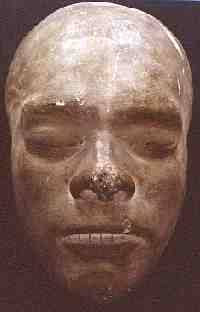
After the good doctors had completed their efforts to advance medical science, a death mask likeness of Le Blanc's face was cast in plaster. Then it was time to carve him up. Le Blanc's skin was peeled off and dispatched to the Atno Tannery on Washington Street to be fashioned into a variety of "charming little keepsakes." A large number of wallets, purses, lampshades and book jackets were produced from the hair follicle studded hide. Strips of skin were sold on the streets, each one personally signed by the honorable Sheriff Ludlow to verify its authenticity. These grisly little souvenirs reportedly found their way into many a respectable Morristown home, where, it is said, many still remain to this day.


The wallet made from Le Blanc's skin


As the years passed most of the residents of Morristown seemed content to let this dark episode of local justice slip quietly between the pages of the town's history. the story of Antoine Le Blanc, however, proved to be harder to kill than the man himself. Rumors concerning the whereabouts of Le Blanc's remains continued to circulate around the area long after the 1833 dissection. One such local legend was that Dr. Canfield had reassembled the executed man's skeleton to hang in his office. This myth was disproven, however, in 1893, when workers building an addition to the county clerk's office found Le Blanc's missing bones in a small wooden box in the bowels of the old building.

Then, on Halloween night 1995, a startling discovery was made which confirmed many of the long standing rumors concerning the survival of Antoine Le Blanc's epidermal memorabilia in Morristown. While liquidating the estate of the late Carl Scherzer, workers from Dawson's Auctioneers and Appraisers of Morris Plains uncovered the glazed plaster death mask of Antoine Le Blanc stashed away in a box in Scherzer's basement. Soon after this grim discovery, a shriveled change purse made from what appeared to be human skin was found tucked away in an upstairs library of the same house. Scherzer, a retired surveyor, had evidently amassed quite a collection of nineteenth century artifacts during his lifetime. After his death in 1979, the chore of sorting through his museum-like house fell upon the shoulders of his son Douglas, who in-turn called Dawson's.

The death mask of Antoine Le Blanc, along with the skin accessories, were put on display in a glass case at Dawson's, but were not offered for bidding to the packed house at the November 18th auction. After the display was dismantled, the Le Blanc trinkets were presumably returned to the custody of the surviving Scherzer -- or were they? When Weird N.J. phoned a representative of Dawson's, they were not very forthcoming about the Wallet man's whereabouts. They suggested we try asking around at the Morristown room of the local library. We did, but found only non-skin book jackets on their shelves. We decided to return to the scene of the crime.

Over the years the Sayre house, at 217 South Street, has been home to a number of taverns and eateries, including the Turnpike Inn, Society Hill, and Argyles. Today, it is Phoebe's Restaurant, named for the servant-girl who was brutally slain there, and whose spirit, it is said, still haunts the building. Stories of doors opening and closing by themselves, and chilly breezes blowing up the stairway to Phoebe's room have long been part of the house's legend. As we bellied up to the bar, current employees told us of lights going on in the middle of the night, that nobody could even locate the switches for. Somebody had once even felt a cold hand on their shoulder while completely alone upstairs. The bar staff told us that nobody there wants to go down to the basement after closing time, and one time somebody witnessed a lighted candle moving through the rooms of the house with no one carrying it.

We asked the manager on duty if he was familiar with the Antoine Le Blanc saga. "Yes," he said, he did remember reading something about it. "Where might we find the skin?" we inquired. "I think they've got all of that stuff over at the Morris County Museum now," he replied. We gulped the remainder of our beer and set off down the road again with just fifteen minutes left before the museum closed for the day.

"No," said the curator of the Morris Museum, when we asked to see the wallets, "That's awful! We don't have anything like that here." Then she added "Try MacCulloch Hall." We called MacCulloch Hall Historical Museum the next day and spoke with the director.

"Yes," he said, "we know the Scherzer collection quite well, but we don't have any of those Antoine Le Blanc relics. I think I do remember somebody at Acorn Hall mentioning that they had them over there." It was starting to look as though this Le Blanc got around town more than that stiff in "Weekend at Bernie's". We began to wonder if we were involved in some kind of historical shell game.

Acorn Hall, headquarters for the Morris County Historical Society, proved to be as skinless and boneless as a Purdue chicken breast. "Try historic Speedwell," was the only advice they'd offer us.

At Historic Speedwell in Morristown is the house where Alfred Vail and Samuel Morse first demonstrated electro-magnetic telegraphy, the forerunner to modern instantaneous communication. So what could they communicate to Weird N.J. concerning the hide and seek game of Le Blanc paraphernalia? "Try Dawson's Auction House," they told us.

And so it was that our quest for the wallet man came full circle, and we found ourselves on the doorstep of Dawson's in Morris Plains. After being buzzed into the gallery of tagged antiques and high priced bric-a-brac we approached the owner of the establishment. "Bring us the head of Antoine Le Blanc!" we demanded. But unfortunately, he could not. It seems that after a year and a half of collecting dust in one of the auctioneers offices, the death mask and skin items had been returned to Douglas Scherzer, just days before our visit to Dawson's.

"You could try asking Mr. Scherzer to see them," we were told. "He's easy enough to find, he's the chief of police."

Somewhat dizzy from the run-around we had been getting, I must admit that I was a little surprised by Chief Scherzer's response when I phoned him and requested to photograph the Le Blanc death mask.

"Sure," he said, " I don't see why not. I'll bring it into the station house with me. If you want to, you can come here." We set a date to get together, and then I asked him if he might have any other Le Blanc paraphernalia in his possession that could be of interest to us.

"Yes," he replied softly, after a tentative pause, "I have some other things."

"Could you bring in these other things for us to see too?" I asked, being careful not to tip my hand. "Okay," he said.

Two weeks after my phone conversation with Mr. Scherzer, Mark Sceurman and I strolled into the Morris Plains Police Station and asked the officer behind the bullet-proof window to let the chief know we had arrived. We were told to have a seat and that he would be with us shortly. I sat down and watched Mark as he paced back and forth across the waiting room floor, clipboard in hand. The minutes ticked by. After our long journey to find these all but forgotten historical artifacts, here we were, under the same roof as the objects of our quest. Seven, eight, nine, minutes elapsed. I was nervous, and I could tell Mark was also. How do you ask a complete stranger if you can see his souvenirs of human skin? What is the proper etiquette in such a situation as this? These are the questions that I think both Mark and I were asking ourselves, when all of a sudden a door swung open before us.

"Mark, hello. Hello Mark." There in the doorway stood Chief Scherzer, smiling and addressing each of us with one hand holding back the heavy door to invite us in. Balanced on his other hand was a brown cardboard box with "HEAD" scrawled across it in black magic marker.

Douglas Scherzer turned out to be a younger man than I had anticipated -- maybe forty. He was friendly, joking as he lead us to a small, bright room in the back of the station house. Once there he set the tattered parcel down on a formica table and talked openly about what he know of the Le Blanc matter, and of his own father's collection of historic momentos.

"They didn't just cast his head you know," he told us. "They also skinned him and made wallets from his hide."

"Do you have any of those wallets?" I asked sheepishly. He motioned toward the box, which lay still closed at my elbow. I felt like a kid beneath the tree on Christmas morning waiting for his parents' permission to begin unwrapping.

"Let's see what's in the box," I said finally, unable to contain my curiosity any longer. Chief Scherzer folded back the corrugated top flaps of the package, and removed some crumpled up newspaper. He then reached inside and unraveled a white towel to reveal the peaceful face of Antoine Le Blanc. As if merely sleeping, the delicate plaster eyelids closed gently over gracefully intertwining lashes. The pronounced cheek bones sloped down to the broad, smooth lips, which betrayed no expression one way or another. The hollow plaster head seemed to be an almost perfect portrait of the dead man, until you notice that both ears had been hacked off before the cast was made. Perhaps this was merely a way to ensure the easy removal of the mold from the corpse's head, or maybe the ears were just two more trinkets to be sold on the open market. Affixed to the shaved crown of the eggshell white cranium was a small paper tag which stated in 19th century script, "Antoine Le Blanc a Frenchman - murdered Judge Sayre and family - hanged in Morristown, N.J. 1833."

I picked up the fragile sculpture and began to turn it over and over in my hands, inspecting every wrinkle on the dead man's face. Like Hamlet pondering the skull of poor Yoric, I gazed into the closed eyes of Antoine Le Blanc, and at long last, felt that I knew him well.

I set the head down on the table and stepped aside to allow Chief Scherzer to remove the remaining contents of the box. He pulled out a dusty old eight by ten picture frame and handed it to me. Behind the glass was a yellowed newspaper article concerning the Le Blanc case, stuck to a piece of white matte board. Below that, fallen away from the spot where it had originally been mounted, was a small rectangular wallet. It was about four and a half inches long, and a sickly greenish-brown in color. It folded over, and a tongue flap fit neatly into a slot on top to close it. I had never seen anything like it before. This was not the tough, yet supple hide of a cow or pig, which we are all familiar with. Nor was it the shiny, rough and scaly skin of a reptile. This was a thin and frail skin which should never have been tooled in such a manner. This skin was cracked and withered. This was the decaying flesh of a human being. Beneath the dislodged billfold there was an inscription typed on a strip of paper which was also peeling away from the backing board. It read, "A wallet made of human skin allegedly that of Antoine Le Blanc." We took some photographs and then thanked our host for his time.

And so, it would seem, that reminders of this macabre episode in New Jersey history will keep finding their way into the collective consciousness of Morristown. But what has become of the dozens of remaining souvenirs which were culled from the tanned hide of Antoine Le Blanc? We don't know. But with the autumn garage sale season once again upon us, don't be surprised if you bump elbows with a Weird N.J. reporter while canvassing those roadside folding tables. For Antoine Le Blanc will undoubtedly rest in pieces, scattered throughout Morristown, for some time to come, and an old wallet, once a genuine hide, could turn out to be a real find.


Below is another example of Historical human skin

THE RED BARN MURDER

The Red Barn Murder was a notorious murder committed in Polstead, Suffolk, England, in 1827. A young woman, Maria Marten, was shot dead by her lover, William Corder, the son of the local squire. The two had arranged to meet at the Red Barn, a local landmark, before eloping to Ipswich. Maria was never heard from again. Corder fled the scene and although he sent Marten's family letters claiming she was in good health, her body was later discovered buried in the barn after her stepmother claimed she had dreamt about the murder.
Corder was tracked down in London, where he had married and started a new life. He was brought back to Suffolk, and, after a well-publicised trial, found guilty of murder. He was hanged in Bury St. Edmunds in 1828; a huge crowd witnessed Corder's execution. The story provoked numerous articles in the newspapers, and songs and plays. The village where the crime had taken place became a tourist attraction and the barn was stripped by souvenir hunters. The plays and ballads remained popular throughout the next century and continue to be performed today

William Corder's skin


Corder was hanged before an audience of thousands shortly after noon on August 11 1828, just three days after the trial ended. People had travelled from miles around, even from London, to witness the event. Some had arrived as early as five in the morning to get a good view. There were many women in the crowd, some dressed in the most fashionable clothes. On the scaffold, Corder again confessed his guilt. Writer Curtis, who witness the event, described the hanging:
"Everything being completely adjusted, the executioner descended from the scaffold, and just before the Reverend Chaplain (Reverend Mr Stocking) had commenced his last prayer, he severed, with a knife, the rope which supported the platform, and Corder was cut off from the land of the living. Immediately he was suspended Ketch grasped the culprit around the waist, in order finish his earthly sufferings, which were at an end in a very few minutes. In his last agonies, the prisoner raised his hands several times; but the muscles soon relaxed, and they sank as low as the bandage around his arm would permit."


Corder's Bust at Moyse's Hall Museum


Corder's Death Mask
Corder's preserved scalp


The body was taken down after and hour and removed to the Shire Hall where it was cut open from throat to abdomen to expose the muscles. The public were then allowed to file past to view it "divested of all its clothing, excepting the trowsers and stockings." The doors closed at 6pm and the body was prepared for the casts to be made. Both head and face were shaved. Curtis remarks "The countenance did not appear much changed, except that the under lip was drawn down so as to expose the teeth in the upper jaw: this had the effect, in a great degree, of obliterating the indentation which in life was very observable on the top of the chin. There appeared to be a considerable effusion of blood about the neck and throat, occasioned by the pressure of the rope in the moment of strangulation." The body was afterwards taken down for dissection to the County Hospital "in a state of nudity" the hangman having claimed the trousers and stockings as a "matter of right". The dissection began the next day. Parts of the body were preserved. The scalp with one ear attached, along with other relics of the murder, can still be seen at Moyse's Hall Museum in Bury St Edmunds.


14 November 2007

Dead Tamil tigers-displayed naked

Chennai/Colombo, 26 Oct. (AKI/Asian Age) - The separatist rebels of the Liberation Tigers of Tamil Eelam (LTTE) have accused the Sri Lankan military of abusing the conventions relating to the treatment of the war-dead by parading the naked bodies of the 21 of their fighters killed during the rebels' pre-dawn attack on the Anuradhapura airbase on Monday. There were three women rebel fighters among the suicide attack forces of the LTTE, known as the Black Tigers. The rebel groups sent emails petitioning the United Nations over the matter. Independent media reports, backed by gruesome photographs taken on site, said the Sri Lankan troops on Tuesday paraded the naked bodies of the Tamil Tiger commandos killed in their attack on the key northern airbase. The reports said that the army had stripped the bodies of the Black Tigers before putting them on display for the mainly Sinhalese residents near the Anuradhapura airbase. A large crowd of locals, mostly Sinhalese residents, gathered to look at the naked corpses and mutilated body parts loaded in trailers pulled by two farm tractors to the hospital mortuary. Some people even took pictures and a few others filmed the gory scene, reports said.


Faced with widespread criticism, the military has now denied humiliating the dead and argued it became necessary to strip the Black Tigers for any "hidden suicide devices" under their jungle fatigues.While it claimed that the bodies were wrapped in black polythene bags, photographs of the trailer packed with naked bodies and a huge gathering of residents watching in the rain, proved otherwise. The military also said the bodies had been since buried. The opposition Lankadissent.com website alleged that the bodies were displayed "to prevent the mentality of defeat from entering the public mindset in the aftermath of this major military debacle." The site also published pictures of the tractors in procession. The military too had on Tuesday posted photographs of some of the killed Tigers sprawled on the airbase tarmac, some charred, one with eyes wide open and another with a gaping hole in his head. The pro-Tiger Puthinam Tamil website reported that the rebel leader Vellupillai Prabhakaran paid his respects to the Black Tigers killed in the air base attack at a well-organised ceremony on Thursday. It said Prabhakaran garlanded the photographs of the 'martyrs' and lit memorial lamps. Meanwhile, the pro-Tiger website, Tamilnet, quoted the LTTE spokesman Irasiah Ilanthirayan saying that their rebel commando unit Thursday evening ambushed a Sri Lanka Navy bus carrying more than 25 personnel, in Thissamaharama in the Hambantota division of the southern province, killing 6 naval officials and wounding 12.Thissamaharama is 174 kilometres southeast of Colombo and 118 kilometres south of Ampaarai town; it also falls within the parliamentary constituency of the Sri Lankan president Mahinda Rajapaksa. Earlier in the day, the Sri Lankan government said its fighter jets bombed "identified Tamil Tiger position" in the northern region of the country for the second day causing "severe damage", while the rebels commemorated its members killed in the pre-dawn attack on Monday. The Media Centre for National Security said an airstrike was launched against a well-identified Tamil Tiger position, which was "posing a threat" to one of the army front defence lines in the northern Vavuniya district and the rebels sustained 'severe' damage. Earlier on Wednesday, the military claimed Sri Lanka Air Force fighter jets raided an LTTE "Black Tiger" training facility at in Mulaittivu in the rebel-held Vanni inflicting heavy damages.

21 July 2007

Indian Soldier paraded naked by mob


The soldiers
Joginder Singh and Daljit Singh of 57 Rashtriya Rifles unit.

http://www.ibnlive.com/videos/43651/.html


Indian soldiers 'paraded naked'
By Altaf Hussain
BBC News, Srinagar

Hundreds of angry Kashmiri villagers paraded two Indian soldiers naked through the streets after they were "caught trying to rape" a 17-year-old girl, witnesses and newspaper reports said on Wednesday.

Police said they were investigating the incident, which took place late on Tuesday in Kunan, a village north of Srinagar, the summer capital of Indian-controlled Kashmir.

"Two army men in civil dress entered our house in the afternoon demanding food and shelter. They asked my mother to leave and tried to rape me," the girl was reported as saying.

"I resisted and screamed until my neighbours rescued me," she said, according to the Greater Kashmir daily.

Mohammad Usman, a witness, told Reuters by phone that furious villagers had beaten up the soldiers, stripped them, shaved their heads and paraded them through the village market.

"Police fired in the air to disperse the protesters and rescued the two soldiers," said a local police officer, who asked not to be identified.

*************************

Two Indian soldiers have been paraded naked for allegedly attempting to rape a girl in Indian-administered Kashmir, police say.
Angry residents in Kunan village near the northern town of Bandipora beat up the soldiers, stripped them bare and paraded them through the market.

Police have charged the soldiers with attempted rape.

An army spokesman said the charges were baseless, and that the villagers had been incited by "hardliners".

Reports quoting local residents say that the two soldiers, dressed in civilian attire, forcibly entered a house in the village of Kunan on Tuesday evening.

The soldiers are said to have posed as militants and asked the family for food and shelter.

'Gathering intelligence'

The reports said that the soldiers allegedly attempted to rape a teenage girl in the house.

When the girl raised the alarm, neighbours rushed in and joined by the family, beat up the soldiers, stripped them, shaved their heads and smeared soot on their faces, witnesses say.

The soldiers were then paraded naked through the local market by the angry mob, who also shouted slogans against the army.

Police fired tear gas shells and fired in the air to break up the demonstration before taking the soldiers into custody.

Army spokesman Colonel Manjinder Singh said that the soldiers had gone to the village to collect intelligence.

He said some "hardliners" had levelled false allegations against them, and incited the residents.

25 May 2007

AL-QAEDA Torture manual


How-to’ Manual Found in Al Qaeda Safe House Shows Disturbing Torture Methods
Thursday, May 24, 2007

The book guides followers of Al Qaeda how to interrogate and torture captives.

The drawings and cartoons depict ways to use electric drills and irons, meat cleavers and other devices to force victims to talk or harm them.

Some of the drawings show how to drill hands, sever limbs, drag victims behind cars, remove eyes, put a blowtorch or iron to someone’s skin, suspend a person from a ceiling and electrocute them, break limbs and restrict breath and put someone’s head in a vice.

Items found at the safe house include electric drills, hammers, blow torches, meat cleavers, pliers and wire cutters, chains, screw drivers, whips and handcuffs.

Earlier this week U.S. troops found the information near Baghdad, along with five Iraqis being held.

Gen. Peter Pace, chairman of the Joint Chiefs of Staff, told reporters Thursday that Al Qaeda poses a dangerous threat to the United States for years to come.

"Clearly, whatever military advice we give, both in Iraq and regionally, must take into account that this group — of Al Qaeda — has targeted free nations, to include the United States, and how our long-term plan and our long-term recommendations must deal with that very real threat to the United States," Pace said at a Pentagon briefing.

Defense Secretary Robert Gates said the United States continues to direct most efforts to defeating Al Qaeda, but he predicted insurgents in Iraq will ramp up attacks this summer

"I think the worry that we have is clearly what we have seen over the past year: that whatever progress is made — and particularly in the last few months — often is overshadowed when Al Qaeda will launch a major attack that kills a lot of innocent civilian Iraqis," Gates said.