Showing posts with label Religion. Show all posts

03 February 2007

Lynched in Indonesia


American human sacrifice in Mexico

American Found In Mass Grave


BROWNSVILLE, Texas (AP)

Police found a mass grave just south of theMexican border Tuesday containing the bodies of a dozen people who werethe victims of human sacrifice by a satanic cult of drug smugglers,officials said. ``It was horrible,'' Cameron County Sheriff Alex Perez told a newsconference in this border city. ``It was like a human slaughterhouse.''

Mexican federal police arrested four people, said sheriff's Lt.George Gavito. Gavito said the suspects were U.S. and Mexican citizens,but did not identify them further. The dead found by the federal police included 21-year-old Universityof Texas student Mark Kilroy, who vanished during his spring break lastmonth while in the Mexican city of Matamoros, Gavito said. Kilroy apparently was chosen at random by drug smugglers who hopedhuman sacrifices would protect them from harm, Gavito said. He was takenafter the cult members ``were told to pick one Anglo male thatparticular night,'' the lieutenant said.

The cult had been involved in human sacrifices for about nine months,he said, and prayed to the devil ``so the police would not arrest them,so bullets would not kill them and so they could make more money.'' Authorities would not comment on the other victims, and would not saywhether any were U.S. citizens. The 12 bodies were found Tuesday morning in a field about 20 mileswest of Matamoros, along with evidence of voodoo or magic, Gavito said. ``I've been an investigator 15 years and it's one of the worst thingsI've ever seen,'' he said.


Kilroy, a pre-medical student, vanished from a crowded Matamorosstreet shortly after 2 a.m. on March 14 while on a drinking foray with agroup of friends in Matamoros, a city of 180,000 just across the RioGrande from Brownsville. Law officers on both sides of the border were stumped, with no cluesto Kilroy's disappearance despite an intensive search, the questioningof nearly 100 people and a $15,000 reward.

Murder suspect Serafin Garcia related to police what had happened on the night of March 14th. Adolfo de Jesus Constanzo, the leader of the satanic cult and drug smuggling operation, had ordered his followers to abduct one of the many "Anglo" students visiting Matamoros during spring break week. The student, Constanzo had explained, had been needed for a "human sacrifice." Kilroy was the unfortunate soul chosen.


As Mark Kilroy had made his way through the crowded Matamoros, Garcia had approached and offered him a ride back to Brownsville. After getting into Garcia's truck, Kilroy was beaten, bound, and driven to the ranch. Twelve hours later, after enduring the tortures of his abductors, Kilroy was killed by a machete chop to the back of his neck. His legs were then cut off at the thighs, and his brain and spine were removed for use in the cult's satanic rituals.


"It was a religion," Garcia explained nonchalantly, as he was paraded with the other suspects before the media by the Mexican police. Altogether, the suspects admitted to 14 killings over a nine-month period. All but three had been chosen at random for human sacrifice, the remaining three apparently killed in retaliation for bungled drug operations. Texas Attorney General Jim Mattox commented: "They believed they had some kind of magical shield to protect themselves from harm or from bullets. And they engaged in human and animal sacrifices to ward off danger."


The 3-foot-deep grave containing Kilroy's body was found afterMexican federal police alerted U.S. officials early Tuesday that theyhad obtained confessions from the suspects, officials said. At least one of the suspects admitted involvement in Kilroy's death,said Oran Neck, chief U.S. Customs agent in Brownsville. The student's parents, Helen and James Kilroy of Santa Fe, Texas,arrived in Brownsville on Tuesday following the grisly discovery. Authorities refused to talk about the evidence or pinpoint thelocation of the grave. The area was sealed, Gavito said. The case is being investigated by Customs, the U.S. AttorneyGeneral's Office, Mexican federal authorities and local law enforcementagencies on both sides of the border. It was the third drug-related mass killing discovered near the borderin less than three weeks.
11 December 2006

Execution of a heretic

On the morning of Saturday, February 19, 1600--the year the twenty-nine-year-old Kepler started to work for Brahe--Giordano Bruno, the eclectic Dominican friar and Italian Renaissance philosopher, was taken from the cell in Rome's Nona Tower he had occupied for seven years, stripped naked, gagged, tied to a stake, and paraded through the cramped streets at the head of a hooded group of chanting inquisitors known as the Company of Mercy and Pity. But they had neither. Bruno's tormentors told him that a last-minute recantation for his sins would save him from eternal damnation as a heretic. Bruno could not have expressed contrition even if he had wanted to, since his jaw was clamped shut, a spike pierced his tongue, and another spike stuck in his palate. There was no way the men in the hoods would allow the man they were about to murder to tell the crowd at the Campo de' Fion in front of the Theater of Pompeii, where the procession finally stopped, what he had told Cardinal Robert Bellarmine, the Catholic Church's greatest intellectual: "I neither ought to recant, nor will I. I have nothing to recant, nor do I know what I should recant." Later, he sealed his fate by showing contempt for his accusers. "In pronouncing my sentence," said Bruno, who had taught in Paris, Oxford, and Wittenberg, "your fear is greater than mine in hearing it." With a torch in one hand and a crucifix in the other, one of Bruno's killers demanded repentance one last time. The condemned man disgustedly turned his face away. The fire was lit and one of history's most profound and original thinkers was burned alive.

Apostols torments

They seized Paul and Silas and dragged them into the market place before the authorities, and when they had brought them to the chief magistrates, they said, "These men are throwing our city into confusion.

Paul and Silas are taken into the market place before the authorities. At the center of the marketplace of Philippi was the forum. On the north side of the forum stood a raised platform. It was known as the Bema -- the seat of judgment. It was here that Paul and Silas were brought.

And the crowd rose up together against them, and the chief magistrates tore their robes off them, and proceeded to order them to be beaten with rods. 23 And when they had inflicted many blows upon them, they threw them into prison, commanding the jailer to guard them securely; 24 and he, having received such a command, threw them into the inner prison, and fastened their feet in the stocks

Notice the mob mentality that is at work. This all takes place in the public square of the marketplace. The crowd gathers and it moves against Paul and Silas. The magistrates order the two men to be stripped of their clothes and beaten. Shame and pain are mixed together as many blows are inflicted. But that is not all. They are then thrown into prison and their feet are secured in stocks. They will be forced to sit in an uncomfortable position for hours upon end with no relief.

What would have been your attitude in such circumstances? Beaten, mocked, stripped naked, rejected, and now forced to sit in uncomfortable stocks amidst your own refuse in the most unsanitary conditions imaginable.

22 November 2006

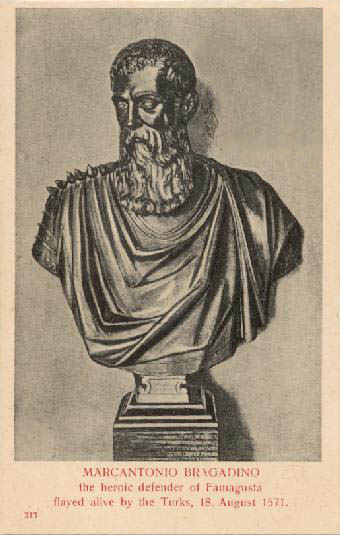
Marcantonio Bragadino Venetian commander


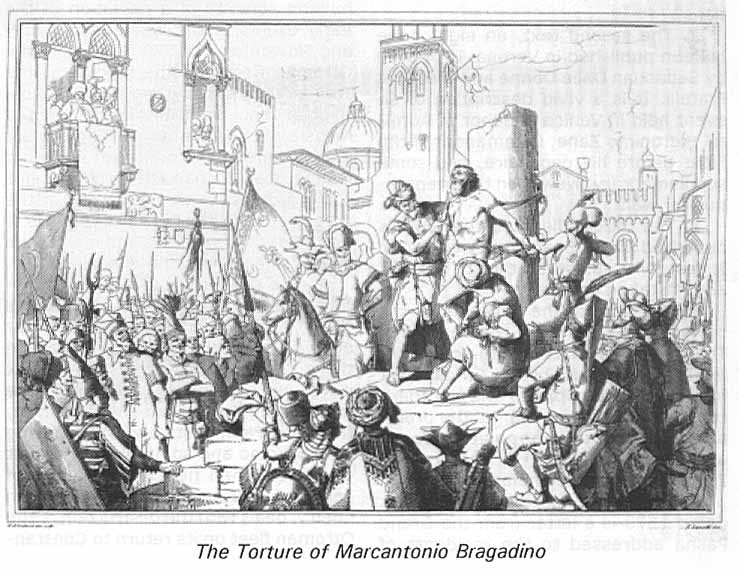
Marcantonio Bragadino who surrendered to theTurks was given very special treatment - it began with the slicing off of his nose and ears. He was whipped daily, given hard and humiliating labour , forced to kiss the earthunder the Turkish general's feet. His teeth were broken and then in Famagusta's central square - flayed alive. His voice , reciting the misere mei Deus ,gradually weakened. He was dead by the time his executioners knives reached his groin. His skin was stuffed with straw , hung from the mast of Mustapha'sflagship and passed in triumph along the Cypriot coast.


Marcantonio Bragadino- Venetian commander <1569-1602>

The admiral Marcantonio Bragadino was a remarkable Venetian commander who defended Famagusta during the wars of XVIe century against the Turks. It was shown compétant and courageous but, at the end of several months of seat, it was obliged to go. The Turkish chief offered honourable conditions to him and Bragadino left the fortress to sign rendering, vêtu dress crimson of its load, accompanied by the officers by his staff and protected from the sun by a large red umbrella from ceremony. The pasha accepted it initially courteously. But suddenly, during the ceremony, Turkish rose of a jump, showed Bragadino of atrocities towards the prisoners and ordered that the Venetian officers are massacred on the spot.The fate of Bragadino, was worse still. With three recoveries, it was about to be decapitated and by refinements of cruelty, one ordered to the torturer to stop. Its nose and its ears were cut, its body was mutilated, and during 10 days it was, each morning, charged with ground baskets, led on the Turkish fortifications and to stop in front of the tent of the pasha where it was to kiss the ground. One hoisted it with the yard of a ship and one let it be balanced there during hours. It suffered all kinds of mocking remarks sadistic and degrading. Finally, it was led on the great place of the city, was stripped, connected with a pile and sharp sectional view in the presence of the pasha. Its skin was empaillée and walked in the streets on a cow, with its red umbrella above him signs derision of it. And when finally the pasha regained in triumph the Gold Horn, this macabre trophy was balanced with the bowsprit of the ship standard.The skin was preserved at the arsenal Turkish of Constantinople. Years later, the Venetian ones took it again, some say bought it and others stole it. One can see today below the bust of Bragadino a small stone ballot box where its yellowed and seamed skin rests, carefully folded, like a handkerchief in a drawer with linen.

Excerpt

October 7, 1571

Near the Gulf of Lepanto

The future author of Don Quixote, Miguel de Cervantes, served on one of the Christian galleys in what he called the greatest naval sea battle in history and the most important to that time for the safety of Europe. The Turks had been massing an enormous fleet for an invasion of Italy. The preparations began to be reported on many months in advance. It was the year 1571 when that fleet was gathered near a port in Greece, not far from the Gulf of Lepanto.For over a year, Pope Pius V had tried to alert the great powers of Europe to the coming menace. But England, France, and the regional powers of what later became Germany were preoccupied with the turmoil of the Reformation.Only Don Juan of Austria, the bastard son of the king of Spain, was stirred by the danger. Despite his youth, despite his modest standing, Don Juan sent out urgent appeals and eventually gathered a sturdy fleet, outfitted with new warfare technologies invented in the West and rapidly mass-produced by the fledgling ship-building and armament firms of what was later to be called “Western capitalism.” He gathered fleets from Venice and Genoa, from Spain, and from the Knights of Malta. In a deliberately preemptive strike, blessed by the pope, this small fleet set sail to catch the Turkish armada before it left the waters of Greece.The Venetians, on the left flank of the battle line, were especially passionate. Not long before, the Turks had so battered an island port maintained by Venetians (and others) that the Venetian commander, Marcantonio Bragadino appealed for a truce. The Turks promised him and his subjects safe passage — and then took him prisoner, beat him, cut off his nose and ears, put a collar on him, and made him crawl like a dog before the conquering army. In a little cage, he was hoisted up on the mast of the galley so that all in the fleet and on land could see him. Then he was brought down flayed mercilessly, his skin carefully stripped from his body as he died (the skin was later stuffed with straw and sent off to Constantinople as a trophy). Thousands of Venetians and others were slaughtered on the spot, or driven off in captivity for service on Turkish galleys or in Turkish harems.But other elements of the Christian fleets were also angry. For decades now, the Turks had used their near-supremacy in the Mediterranean to make constant raids on the Christian communities near to the sea, and hauled away young women and men for the harems, and stronger men for the galleys.Indeed, many of the galley slaves pulling the oars of the Turkish fleet sailing proudly and confidently into the Gulf of Lepanto were Christians captured in these and other ways. There they were starved, beaten, and living in their own waste, kept just strong enough to pull on the great oars, to which they were chained. Furiously, below decks, some of these galley slaves were struggling to break through their chains once the battle was joined. Finally some did, and rose up from below deck swinging their chains and causing mayhem among already embattled Muslim sailors.

Other source

As the Captain of the Venetian forces at the siege of Famagusta on Cyprus in 1571 Bragadin suffered one of the most brutal and painful deaths imaginable, during a period of history that turned out to be very significant in the relationships between the Christian states of the 'West' in Europe and the Islamic empire in the 'East'.

I'm currently reading a 1936 work by H.V. Morton called "In The Steps Of St. Paul", and he recounts the story of Bragadin's death thus:

When the Turks entered Famagusta, this gallant soldier was brought before the Turkish general, Lala Mustafa, who pretended to execute him. He was forced to bare his neck three times to the executioner's sword, which each time was slowly lowered. Eventually, at a sign from the Turk, his nose and ears were cut off. "Where is your Christ now?" asked the Pasha. "Why does He not come and help you?" Those who watched the scene have left accounts in which they tell with what dignity and in what proud silence the tortured man bore himself. For ten days he was forced to carry earth to the ramparts and to kiss the ground each time that he passed the Pasha's tent. Then he was hoisted in a slung seat, with a crown tied at his feet, to the yard-arm of the flagship, and thus exposed to the jeers of the Turkish forces. At the end of ten days Bragadino was led with drums and trumpets to the great square of Famagusta, stripped, tied to a pillar, and slowly flayed alive ... Bragadino's skin, stuffed with straw, was tied to a cow and, with a red umbrella held over it in mockery, was paraded through the town. The tortured body was cut up like meat and portions hung on the gates of Famagusta. When the Turks sailed for Constantinople they tied the stuffed skin of Bragadino to the yard-arm and paraded it round the ports of the Mediterranean.

My sources dispute what happened next. Alberto Toso Fei's "Venetian Legends and Ghost Stories" book claims that the skin was captured from the armoury in Constantinople where it was on display as a war trophy. H.V. Morton claims that it was sold back to Bragadin's sons at a price. Either way the skin of the Ventian captain now resides in an urn set into a marble tribute to him, which features a head-and-shoulders bust of Bragadin and a sculpted relief of his death scene.

Fei's book quotes chronicles of the time describing the skin when it arrived in Venice:

It was folded in the width of a sheet of paper, solid and palpable as if it were a small cloth; you could still see the hairs of the chest attached to it, and on the right hand which had been skinned the unfinished fingers with the nails which still seemed alive...

21 October 2006

Priest beaten stripped naked and paraded by mob

The incident that became a national scandal concerned the forced stripping of Father Christudas, twice in a day last year. Christudas was the vice-principal of St Joseph's High School in Guhiajori of Bihar's Dumka district. A seventh class boy, Sakal Hansda, alleged that the priest had fondled his genitals in his room on August 30.

Four days later, three senior boys accompanying Hansda forced Christudas to walk with them to the bishop's house in Dudhani, Dumka, 13 kilometres away, to register a complaint. The apprehensive principal of the school, Father Joachim Lakra, followed them. A mob soon gathered after them.

Three kilometres from the school, according to a report of the Minorities Commission, Subdivisional Magristrate Harendra Sharma met the group. When Lakra urged him to intervene, Sharma apparently said he had only his personal staff, but assured that nothing would happen.

A little later, Santhal Parganas college students led by a student leader, who had attacked another of the school's priests in 1995, burst upon Christudas, hit him on the head with a hockey stick, punched and kicked him, stripped him naked, cut up his hair with scissors, put ash all over his face, and garlanded him with chappals and shoes. Christudas ran and hid inside a district administration jeep but was dragged out and beaten again and made to walk.

At the mofussil police station he was thrashed again. In the main street of Dumka, the district collector (since transferred), A Jha, whose wife St Joseph's employed, in the presence of N P Singh, the superintendent of police (also transferred), ordered Christudas to the town police station. The Commission's report quotes witnesses saying that Jha was abusive. Christudas was handed his clothes back.

The Commission has been unable to determine what happened in the backrooms in the next 15 minutes. Except that soon policemen were ordering Christudas out of his clothes and out of the police jeep and handing him back to the mob to be beaten and dragged to the Bishop's house. The Commission says a telephone order came to policemen; who made it for what is being inquired by the Central Bureau of Investigation.

Christudas was a disciplinarian and had removed some students from the hostel. The Commission's case is that the collector, without the most preliminary of investigations into Christudas's alleged sexual misconduct, branded him, acquiesced in his being returned to the maddened mob, and demanded of the Church to expel him. As for his subordinates, the next day's newspapers published pictures of a naked Christudas flanked by policemen looking as smug as the students.

"Almost the entire senior district staff is of non-tribal origin,'' says the Commission's report. ''Many of (them) have open or latent sympathy for the BJP. In Dumka's largest education institute (SP college) the BJP-RSS frontal organisations control the students' union and have a following among the teaching staff, including the acting principal of the college."

20 October 2006

Detailed story of Human Sacrifice

Among the Meriah: "Human sacrifices were offered to the Earth Goddess by tribes, branches of tribes, or villages, both at periodical festivals and on extraordinary occasions. The periodical sacrifices were generally so arranged by tribes and divisions of tribes that each head of a family was enabled, at least once a year, to procure a shred of flesh for his fields, generally about the time when his chief crop was laid down.

festivals and on extraordinary occasions. The periodical sacrifices were generally so arranged by tribes and divisions of tribes that each head of a family was enabled, at least once a year, to procure a shred of flesh for his fields, generally about the time when his chief crop was laid down.

All of the Babylonian, Cannanite, or Egyptian worship of the Hebrews came out of this area. All ritual with music and sacrifice was a fertility ritual. The Feast of Tabernacles to which Jesus at first refused to attend was a giant fertility ritual much like the modern Jubilee where the "sacraficial victims" are the enemies of the musical team playing around the "trees" or Asherah poles or free-standing, non-functional columns.

The mode of performing these tribal sacrifices was as follows. Ten or twelve days before the sacrifice, the victim was devoted by cutting off his hair, which, until then, had been kept unshorn.

Crowds of men and women assembled to witness the sacrifice; none might be excluded, since the sacrifice was declared to be for all mankind. It was preceded by several days of wild revelry and gross debauchery.

On the day before the sacrifice the victim, dressed in a new garment, was led forth from the village in solemn procession, with music and dancing, to the Meriah grove, a clump of high forest trees standing a little way from the village and untouched by the axe.

There they tied him to a post, which was sometimes placed between two plants of the sankissar shrub.

He was then anointed with oil, ghee, and turmeric, and adorned with flowers;

and a species of reverence, which it is not easy to distinguish from adoration, was paid to him throughout the day.

A great struggle now arose to obtain the smallest relic from his person; a particle of the turmeric paste with which he was smeared, or a drop of his spittle, was esteemed of sovereign virtue, especially by the women.

The crowd danced round the post to music, and addressing the earth, said, "O God, we offer this sacrifice to you; give us good crops, seasons, and health";
then speaking to the victim they said,

"We bought you with a price, and did not seize you; now we sacrifice you according to custom, and no sin rests with us."

On the last morning the orgies, which had been scarcely interrupted during the night, were resumed, and continued till noon, when they ceased,

and the assembly proceeded to consummate the sacrifice.

The victim was again anointed with oil, and each person touched the anointed part, and wiped the oil on his own head.

In some places they took the victim in procession round the village, from door to door, where some plucked hair from his head, and others begged for a drop of his spittle, with which they anointed their heads.

As the victim might not be bound nor make any show of resistance, the bones of his arms and, if necessary, his legs were broken; but often this precaution was rendered unnecessary by stupefying him with opium.


The mode of putting him to death varied in different places. One of the commonest modes seems to have been strangulation, or squeezing to death.

The branch of a green tree was cleft several feet down the middle; the victim's neck (in other places, his chest) was inserted in the cleft, which the priest, aided by his assistants, strove with all his force to close.

Then he wounded the victim slightly with his axe, whereupon the crowd rushed at the wretch and hewed the flesh from the bones, leaving the head and bowels untouched.

Human Sacrifice and Cannibalism

Sir James George Frazer (1854&endash;1941). The Golden Bough. 1922. On human Sacrifice.

Among the Lhota Naga, one of the many savage tribes who inhabit the deep rugged labyrinthine glens which wind into the mountains from the rich valley of , it used to be a common custom to chop off the heads, hands, and feet of people they met with, and then to stick up the severed extremities in their fields to ensure a good crop of grain.

They bore no ill-will whatever to the persons upon whom they operated in this unceremonious fashion.

Once they flayed a boy alive, carved him in pieces, and distributed the flesh among all the villagers, who put it into their corn-bins to avert bad luck and ensure plentiful crops of grain.

The Gonds of India, a Dravidian race, kidnapped Brahman boys, and kept them as victims to be sacrificed on various occasions.

At sowing and reaping, after a triumphal procession, one of the lads was slain by being punctured with a poisoned arrow.

His blood was then sprinkled over the ploughed field or the ripe crop,

and his flesh was devoured.

Human Sacrifice and Ritual murder by JEWS

1823. Velisch, Russia. On Easter Sunday, a 21 year old boy disappeared. His body was found in a marsh one week later; there were punctured wounds all over the body and the skin was scarified. There were wounds of circumcision; the feet were bloody and a bandage had been tied around the legs. The body had been undressed, washed, and again dressed. No blood was found near the body, which was drained of blood. Doctors gave evidence on oath that the child had been tortured to death. Some years later, five Jews were arrested together with three Russian women who had become Jewesses; these three women confessed that they had, one week before Passover in 1823, been made drunk by a Jewess who kept an inn and that the latter had bribed one of them to procure a boy. One of these converted Jewesses described how the boy had been forcibly circumcised by the Jews and rolled about in a barrel until his skin was scraped all over. The boy had been taken to the school where a number of Jews were assembled, laid in a trough, and all present had made stabs with a nail in his side and temples. When the boy died under this torture, his body was taken to a wood by two of the converted Jewesses; and the third woman took a bottle of the blood of the boy to the Jewess innkeeper aforesaid. Next day, the Rabbi's wife took the three women again to the school where the Jews were gathered; bottles were filled from the trough by means of a funnel, and the Rabbi dipped a nail into the blood and dropped a little onto a number of pieces of cloth, one piece of which was given to everyone present. The case went to the Imperial Council at St. Petersburg, all the lower courts which dealt with the case having found the Jews guilty. The Imperial Council reversed the verdict and, on 18th January, 1835, the three Russian Jewish convert women were sent to Siberia whilst all the Jews were acquitted of the crime! Authorities: Recorded in the Jewish Encyclopedia, 1903, Vol. III, p. 267; described in Der Sturmer, May, 1934.

Human Sacrifice- INDIA

And on 13th September, 1937, a telegram was sent to The Times from Delhi reporting the sacrifice of a 17-year-old youth to propitiate the rain-god, in Sirmoor State. The youth was led through the village of Gunpur by a crowd of people headed by a priest and the village headman, and beheaded on a special altar to the accompaniment of devotional songs. The head was found by the police at the foot of the deity in the village temple.

As Aryan rule over India relaxes, Thuggee and other human sacrifices will re-appear.