Showing posts with label WAR. Show all posts

03 January 2012

Hanged nude

I always thought that there's really nobody who was hanged totally naked.. until I read about the case of Dietrich Bonhoeffer. He was a Lutheran pastor and also an undercover agent. He was arrested for the presumed participation in the assasination attemp on Adolf Hitler. His execution is quite brutal and humiliating as with other prisoners associated with the failed assasination plot. He was stripped totally naked and led to the execution yard. He prayed before he was hanged.

I've read about Sandanista movement in Chile executing there prisnoer in the nude but there's no proof that it really happen. The case of Dietrich however is true.

02 January 2012

Downed B29 crewmen

I was forever haunted by the identity of the four pilots who was captured alive, paraded naked and beheaded in public by the Japanese in Singapore during WW2. So I made my research online on the probable identities of those 4 crewmen. Its not easy because there's no direct articles about the incident, so its like putting a puzzle. Initially, I searched about the downed aircraft in Singapore during the years 1944-1945. I found that there were two B-29 aircraft which were downed during the Singapore raid. From there, I was able to know the names and the incident.

B29 Bomber- 42-65226


Below is the missing link I was looking for several years.

677th Squadron - 444th Group - 58th Wing -20th Air Bomber Command

11 Jan 1945. 42-65226

The B29 Bomber designated as serial number 42-65226 flying out of Dudhkundi, India was scheduled for a combat mission over Singapore, Malaya. The regular engineer for the mission was temporary at rest camp, and 1st LT Charles Vail was assigned to take his place. Two minutes prior to acquisition of the target during the bombing run, the plane was hit with Flak, and it exploded. Some of the crew were expelled from the plane, some bailed, and some were unable to bail out in time. All had the misfortune of landing almost on their intended target.

Three men died in the crash. SGT Wolk and SGT Vail died in the crash, and were identified at the scene. Another unidentified, was probably TSGT Holt, because of a Minnesota sports article found with the remains.

SSGT Ellis and SSGT Gumbert were the left and right gunners. They survived the initial explosion and subsequent crash. However, SSGT Gumbert's injuries were severe and his remains were found near the wreckage.

MAJ Wilson, LT Fitzgerald, 1st LT Heiss, and 1st LT Yowell survived the explosion of the plane, and were gathered together by Chinese guerrillas the night of 11 Jan 1945.

1st LT Yowell and 1st LT Heiss were separated from MAJ Wilson and LT Fitzgerald because the latter were injured and had to be carried by stretcher. The Chinese guerrillas would later report that Yowell and Heiss were unsuccessful crossing the road near a Japanese guard post.

LT Fitzgerald and MAJ Wilson were later reunited with SSGT Roberts who also had survived and been found by the Chinese guerrillas and they were all extricated by a British submarine.

SSGT Ellis, 1st LT Osterdahl, 1st LT Yowell and 1st LT Heiss were all captured on or about 12 Jan 1945, taken to Seletar Singapore, where they were interrogated by Lieutenant Commander Okamoto Tonshio, Engineer Staff Officer of the 10th Special Base Unit. The prisoners were confined in a wooden hut near the Naval Club at Seletar and were guarded by the men of the Land Deputy Command under OC Lt Yamaguchi Wataru which was a part of the 10th Special Base unit. For a period of about a week, the four prisoners were tortured.

SSGT Ellis had been captured as his parachute brought him to earth. He was beaten severely in public, and paraded through the streets once taken to Singapore. He shouted "Good for me and bad for you!" while he was beaten.

On the evening of 10, Feb. 1945, a party headed by Sub-Lieutenant Koayashi and Warrant Officer Toyama took the four prisoners to Nee Soon rifle range where they were beheaded. The bodies were initially buried, but were later dug up and cremated to hide the evidence of the war crimes. Lieutenant Commander Okamoto issued additional instructions for all his subordinates to keep quiet about the incident.


The unfortunate crewmen were;
Ellis, Samuel B., Jr (S/Sgt) - Left Gunner
Osterdahl, Carrol N. (1st Lt) - Navigator
Heiss, Edward (1st Lt) - Bombardier
Yowell, Robert W. (1st Lt) - Radar Operator


1st Lt Edward Heiss


Link
http://www.geni.com/projects/WWII-Missing-Air-Crew-Report-10878

13 December 2011

The death of Col.William Crawford


The Moravians capture a Colonel Crawford and Dr. Knight in June of 1782. They strip Crawford naked and tie him to a stake surrounded by kindling about 5 yards out from the stake. He spends the night in this position with full knowledge that he is to be tortured the next day.


At the beginning of his ceremonious torture the chief speaks for over half an hour and is then followed by triumphant screaming upon the ending to his speech by the tribe. All the men and at least half the women crowd around the colonel with flintlock rifles loaded with extra-large loads of powder only. The closest were within a few feet when they shot at him in turn.

The grains of powder, saltpeter still burning, peppered his skin, some of it puncturing and continuing to burn just beneath the skin. Crawford screamed until he was hoarse and then only a kind of whimpering grunt issued from him. More than seventy powder charges had struck him everywhere from feet to neck, but the greater majority had been aimed at his groin, and when they were finished the end of his penis was black and shredded and still smoking.

The crowd thinned momentarily as the guns were returned to the wegiwas, but as soon as all the Indians had reassembled, Chief Pipe stepped up to Crawford and with two swift movements sliced off his ears. From where he sat watching in horror, fifty feet away, Dr. Knight could see blood flowing down both sides of Crawford’s head, bathing his shoulders, back and chest.

Now came squaws with flaming brands and they lighted the kindling all the way around the circle, igniting the material every foot or so until the entire circle was ablaze. The poles quickly caught fire on their tips and the heat became intense, causing the closest spectators to fall back. A peculiar, hair raising animal sound now erupted from Crawford. He ran around the post in a frenzy, finally falling to the ground and wrapping his body around the stake. After the better part of an hour the fire died down, leaving a fanned out ring of long poles, each with one end a glowing spike.

Crawford’s back buttocks and the skin on the back of his thighs had blistered and burst and then curled up into little charred crisps. The animal sounds were fainter now.


In groups of four the Indians now began taking turns at a new torture. Each of the four would select a pole and jab the glowing end onto Crawford’s skin where they thought it would give most pain. Dr. Knight thought Crawford near death by now, but was amazed to see the officer scramble to his feet and begin stumbling about the stake, attempting to avoid the glowing ends which hissed and smoked wherever they touched him. One of the points was thrust at his face and as he jerked to avoid it he ran into another which contacted his open eye, and a fearful shriek erupted from him.

When the poles had all been used and tossed on a pile to one side, some of the squaws came up with broad boards and scooped up piles of glowing embers to throw at him until soon he had nothing to walk upon but coals of fire and hot ashes.

“Girty! Girty! Where are you?” (Girty was a white man that Crawford had known who lived with the Indian tribe. He had initially asked Girty for help to get out of the torture. Although he tried there was nothing that Girty could do to help without risking his own life.) These were the first coherent words Crawford had spoken since before the guns were fired. “Girty, in the name of Christ, kill me! Shoot me. Oh my God, Girty, kill me!”

Chief Pipe, hearing Girty’s name, shot the renegade a stern glare and Girty neither moved nor replied to Crawford’s plea, knowing he was closer to the stake now himself than he had ever thought to be. Most of the Indians did not understand what Crawford was saying, but the beseeching tone of voice pleased them and they clapped their hands and shouted aloud in triumph at having forced the white chief into this outburst.

When there was no answer to his cries, Crawford began a shuffling walk round and round the stake as if in a trance, scarcely flinching as he stepped on the hot coals. Finally he stopped and slowly raised his head and his voice came out surprisingly loud and clear.

“Almighty God, be with me now. Have mercy upon me God. I pray you to end this suffering so that I might be with you where there is no pain and suffering. Oh God, dear God, help me!”

Once more he began the same shuffling walk until at last, two full hours after having been prodded with the glowing poles, he fell on his stomach and lay silent. At once Chief Pipe stepped over the ring of ashes and cut a deep circle on the top of Crawford’s head with his knife, wrapped the long dark hair around his hand and yanked hard. The pop as the scalp pulled off was clearly audible to Girty and Dr. Knight.


(The chief makes a spectacle by rubbing the scalp in Dr. Knight’s face until a murmur arises from the crowd behind him.)


A squaw had entered the circle of ashes with a board heaped full of brightly glowing coals, and these she scattered on Crawford’s back and held them with the board against the officer’s bare skull. The murmur that had arisen was occasioned by what seemed wholly unbelievable: Crawford groaned faintly and rolled over and then slowly, ever so slowly, drew up his knees and raised himself to a kneeling position. For perhaps two minutes he stayed like this and then he placed one foot on the ground and stood erect again, beginning anew that queer shuffling walk. A few squaws touched burning sticks to him but he seemed insensitive to them, no longer even attempting to pull away. It was the most appalling sight Dr. Knight had ever witnessed and unable to control himself any longer, he suddenly vomited and then screamed at his captors, cursing them and calling them murderers and fiends and devils, blaming Girty more than anyone else.

(The chief then orders the squaws to build another fire.)

When the fire reached its peak, two warriors cut the rawhide cord that bound the still shuffling Crawford and, one on each side, let him shuffle toward the fire. When the heat became too intense for them to advance closer, they thrust him from them and he sprawled onto the blaze. His legs jerked a few times and one arm flailed out but then, as skin and flesh blackened, living motion stopped and all that remained was a gradual drawing of arms and legs close to the body in the pugilistic posture characteristic in persons burned to death.

So ended the life of Colonel William Crawford.

Phallotomy- Penis as trophy

Following a massacre, it was not uncommon for warriors to
bring back heads or some other bodily part to prove how many
enemies were killed. Sometimes the bodily part would be a scalp,
hand, foot, or ear. But when Saul offered his daughter to David
in exchange for killing one hundred Philistines, the bodily part
he required was none of these. The part Saul required was the
penis!

David was to bring back one hundred Philistine "foreskins"
(1 Samuel 18:25). Bergmann, Gesemus, and other scholars have
pointed out that the word translated "foreskins" includes the
entire male member: "basr ha-ghurleh" meaning prepuced penis,
"basr" being euphemistic for the male organ itself and "ghurleh"
being the "sheath" thereof.

"Phallotomy" - cutting off the penises of victims - had long been
considered proof of bravery. Egyptian soldiers exhibited
thousands of penises before Ramses III following the battle of
Khesef-Tamahu. Among the people of Mowat a victor in battle would
wear about him the penis of his conquered enemy; it was
considered good luck to do so. The women of Cush cut off the
penises of wounded or slain men and stuffed them in the mouths of
their enemies. The nomad Danakil who roamed the eastern desert of
Ethiopia were fanatical collectors of phallic trophies. The
Hittites and Arabs did the same. An old Bedouin custom required a
warrior to present his bride or her father with the severed
penises of tribal foes.

It is not a pretty picture. David gets some men together and
heads out toward a Philistine settlement. Coming through the
hills, up ahead they see a group of Philistines - apparently
unable to defend themselves - for none of David's men are killed.
As they move in, a couple men grab a Philistine while David
shoves his sword into his stomach. The man cries for mercy; none
is given. David rips the man's clothes open and grabs his penis,
pulls on it, and cuts it off for his collection. He will need at
least one hundred of these to buy his woman.
Saul had asked for one hundred "foreskins," but we read that
David "slew of the Philistines two hundred men; and David brought
their foreskins, and they gave them in full tale to the
king" (1 Samuel 18:27). In the excitement did David kill twice as
many as required? Possibly; but usually the number two hundred is
considered a copyist error. Tke other verses that mention the
number all say one hundred (1 Samuel 18:25; 2 3:14).
Whether one hundred or two hundred, these severed penises
were presented to Saul "in full tale," that is, the full count or
tally. One can imagine the scene as Saul and others with glee
counted - 1,2,3,4, and on up to the full count.
Years later, when king Saul was wounded in battle, he asked
his armor bearer to kill him "lest these uncircumcised come and
abuse me " (1 Chronicles 10:4). He may have feared genital
amputation (in retaliation for what he had ordered David to do to
Philistines), or homosexual rape, the word translated "abuse"
being capable of meaning to thrust in.
It was, apparently, sexual abuse that was also feared by
king Zedekiah when he told Jeremiah: "I am afraid of the Jews
that are fallen to the Chaldeans, lest they deliver me into their
hand, and they mock me" (Jeremiah 38:19). The word that is here.
translated "mock" is the same word that is translated "abuse" in
the case of Saul.

14 November 2007

Dead Tamil tigers-displayed naked

Chennai/Colombo, 26 Oct. (AKI/Asian Age) - The separatist rebels of the Liberation Tigers of Tamil Eelam (LTTE) have accused the Sri Lankan military of abusing the conventions relating to the treatment of the war-dead by parading the naked bodies of the 21 of their fighters killed during the rebels' pre-dawn attack on the Anuradhapura airbase on Monday. There were three women rebel fighters among the suicide attack forces of the LTTE, known as the Black Tigers. The rebel groups sent emails petitioning the United Nations over the matter. Independent media reports, backed by gruesome photographs taken on site, said the Sri Lankan troops on Tuesday paraded the naked bodies of the Tamil Tiger commandos killed in their attack on the key northern airbase. The reports said that the army had stripped the bodies of the Black Tigers before putting them on display for the mainly Sinhalese residents near the Anuradhapura airbase. A large crowd of locals, mostly Sinhalese residents, gathered to look at the naked corpses and mutilated body parts loaded in trailers pulled by two farm tractors to the hospital mortuary. Some people even took pictures and a few others filmed the gory scene, reports said.


Faced with widespread criticism, the military has now denied humiliating the dead and argued it became necessary to strip the Black Tigers for any "hidden suicide devices" under their jungle fatigues.While it claimed that the bodies were wrapped in black polythene bags, photographs of the trailer packed with naked bodies and a huge gathering of residents watching in the rain, proved otherwise. The military also said the bodies had been since buried. The opposition Lankadissent.com website alleged that the bodies were displayed "to prevent the mentality of defeat from entering the public mindset in the aftermath of this major military debacle." The site also published pictures of the tractors in procession. The military too had on Tuesday posted photographs of some of the killed Tigers sprawled on the airbase tarmac, some charred, one with eyes wide open and another with a gaping hole in his head. The pro-Tiger Puthinam Tamil website reported that the rebel leader Vellupillai Prabhakaran paid his respects to the Black Tigers killed in the air base attack at a well-organised ceremony on Thursday. It said Prabhakaran garlanded the photographs of the 'martyrs' and lit memorial lamps. Meanwhile, the pro-Tiger website, Tamilnet, quoted the LTTE spokesman Irasiah Ilanthirayan saying that their rebel commando unit Thursday evening ambushed a Sri Lanka Navy bus carrying more than 25 personnel, in Thissamaharama in the Hambantota division of the southern province, killing 6 naval officials and wounding 12.Thissamaharama is 174 kilometres southeast of Colombo and 118 kilometres south of Ampaarai town; it also falls within the parliamentary constituency of the Sri Lankan president Mahinda Rajapaksa. Earlier in the day, the Sri Lankan government said its fighter jets bombed "identified Tamil Tiger position" in the northern region of the country for the second day causing "severe damage", while the rebels commemorated its members killed in the pre-dawn attack on Monday. The Media Centre for National Security said an airstrike was launched against a well-identified Tamil Tiger position, which was "posing a threat" to one of the army front defence lines in the northern Vavuniya district and the rebels sustained 'severe' damage. Earlier on Wednesday, the military claimed Sri Lanka Air Force fighter jets raided an LTTE "Black Tiger" training facility at in Mulaittivu in the rebel-held Vanni inflicting heavy damages.

22 March 2007

Another from Somalia

MOGADISHU, Somalia (Reuters) -- Somali insurgents dragged soldiers' bodies through the streets of Mogadishu before burning them on Wednesday in heavy fighting that killed at least 16 people and injured scores more, witnesses said.

The corpses of five soldiers -- either from the Somali government army or their Ethiopian allies -- were desecrated during some of the worst clashes in the lawless capital since the interim government took over in December, witnesses said.

In one place, men dragged two semi-naked corpses by the feet while members of a crowd chanting "God is Great" kicked and pelted them with stones, a Reuters reporter said. (Watch a soldier's body being dragged through the street, as civilian casualties also mount )


Scene similar to aftermath of Black Hawk downing

In another, three bodies were hauled round by rope, kicked and then also set alight, witnesses said.

The grisly scenes recalled the aftermath of the 1993 shooting-down of a Black Hawk helicopter by Somali militiamen during a failed U.S. operation to hunt down warlords.

Images of dead American troops being dragged through the streets of Mogadishu were the beginning of the end for a U.S.-U.N. peacekeeping force which quit Somalia in 1995.

As well as the five soldiers, witnesses and medical sources said at least 11 civilians died in Wednesday's clashes.

The fighting, which wounded at least 81 people according to hospital staff, began early in the day when insurgents fired at Ethiopian and government forces in tanks parked at the Ministry of Defense, residents said.

When the tanks moved out to defend their position, fighting escalated because Islamist sympathizers and clans feared they were about to be targeted in a forced disarmament drive.

Two new fighting fronts then opened up in the afternoon.


15 March 2007

Navy Seal Neil Roberts-Executed by Al-Queda

Al Qaeda Executed G.I.During Battle


Soldier fell from copter under fire, was captured & shot
By RICHARD SISK

Daily News Washington BureauWASHINGTON -- Navy SEAL who fell from a helicopter during a mountain firefight was captured by Al Qaeda forces as his commanders watched helplessly on a drone's TV screen and later executed, U.S. battle commanders said yesterday."We saw him on the Predator being dragged off by three Al Qaeda men," said Maj. Gen. Frank Hagenbeck, who watched the battle in real time by a transmission from a Predator spy drone overhead.

Air Force commandos later recovered the body of Navy Petty Officer 1st Class Neil Roberts, 32, after a fierce 14-hour firefight Monday in which seven Americans were killed and two helicopters were lost. Maj. Ralph Mills of the U.S. Central Command said Roberts survived the fall and was executed by gunfire.Hundreds of U.S. troop reinforcements loaded with heavy equipment were airlifted into the mountain battlefield today, preparing for a lengthy confrontation with Al Qaeda forces.

The fresh troops were delivered by helicopter from Bagram airfield, a sprawling former Soviet base north of Kabul that is becoming the focal point for U.S. operations in Afghanistan. They were armed with shoulder-launched rockets and night-vision equipment.Bob Hanson, who lives two doors from the Roberts' family in Woodland, Calif., and knew Neil all his life, said the SEAL's death was a "tragedy.""Neil wanted to do his part for his country," said Hanson, an ex-Army Ranger who served in Vietnam in the early 1960s.

"He said becoming a SEAL was the greatest thing that happened in his life." Despite the losses, Hagenbeck said U.S. troops engaged in Operation Anaconda had killed hundreds of Al Qaeda and Taliban fighters in southeastern Afghanistan.In battle yesterday, Army Apache AH-64 helicopter gunships and Air Force fighters "caught several hundred of them with RPGs [rocket-propelled grenades] and mortars heading toward the fight," said Hagenbeck, commander of New York's 10th Mountain Division. "We body-slammed them and killed hundreds of those guys," Hagenbeck said in the mountain town of Sirkankel.Hagenbeck and Pentagon officials described major gains in the U.S. offensive across the Shahikot mountain range and U.S.-led forces have been able to enter the first cave complexes in the area, finding large caches of weapons.The fiercest fighting, however, occurred Monday, when G.I.s stranded around their downed helicopter fought for more than a dozen hours to protect the wounded and safeguard the bodies of their dead comrades. "We don't leave Americans behind," said Air Force Brig. Gen. John Rosa.Six helicopters were involved in the mission, and two of those were abandoned in the mountains after they were disabled by enemy fire.

Two MH-47 Chinook helicopters began the assault at 3 a.m. Monday by trying to land troops. The first chopper to land took fire and lifted off immediately to escape.As described by Pentagon officials, Roberts fell out as the stricken chopper veered up and away toward safer ground. But another military official suggested the chopper landed, then was hit and everyone except Roberts piled back in as it flew off.At 6:30 a.m., two more Chinooks renewed the assault a few miles from the scene of the first incident. The first chopper to land was hit with withering enemy fire, and six U.S. troops were killed and 11 wounded in the firefight.The second Chinook landed its troops, and they took up the fight. They held their positions in close combat for 12 to 14 hours into the night while waiting for relief.Two more helicopters, thought to be armored Air Force Special Operations CH-53 Pave-Lows, recovered the troops and all the dead and wounded at both sites, and returned to base.Maj. Bryan Hilferty said about 1,000 U.S. troops from the 10th Mountain Division, the 101st Airborne Division and the Special Forces were doing the fighting.The flag-draped coffins of the seven servicemen were flown aboard an Air Force C-17 transport yesterday to Ramstein Air Base in Germany, where honor guards transferred them in a solemn ceremony to a C-5 Galaxy for the flight to Dover Air Force Base in Delaware.With News Wire ServicesOriginal Publication Date: 3/6/02 Daily News ServicesExcerpted from the March 16, 2002 edition of Bits N Pieces, the newsletter of the National Alliance of Family.

26 December 2006

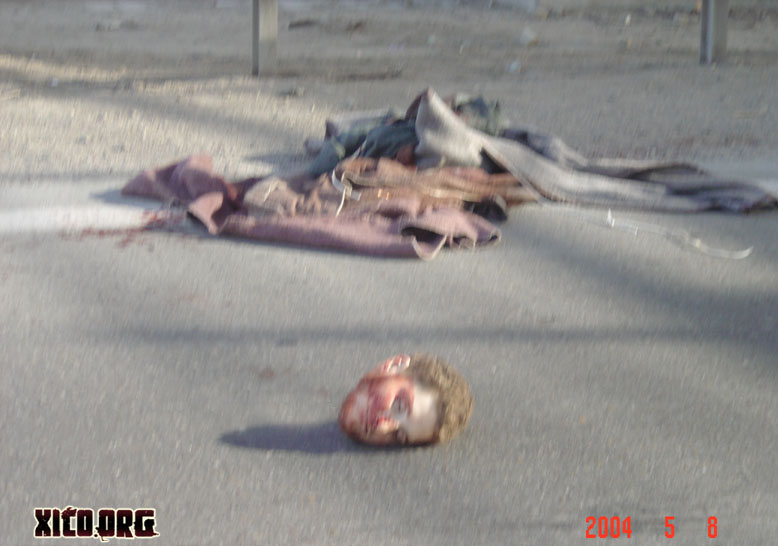
Nick Berg's death in Iraq


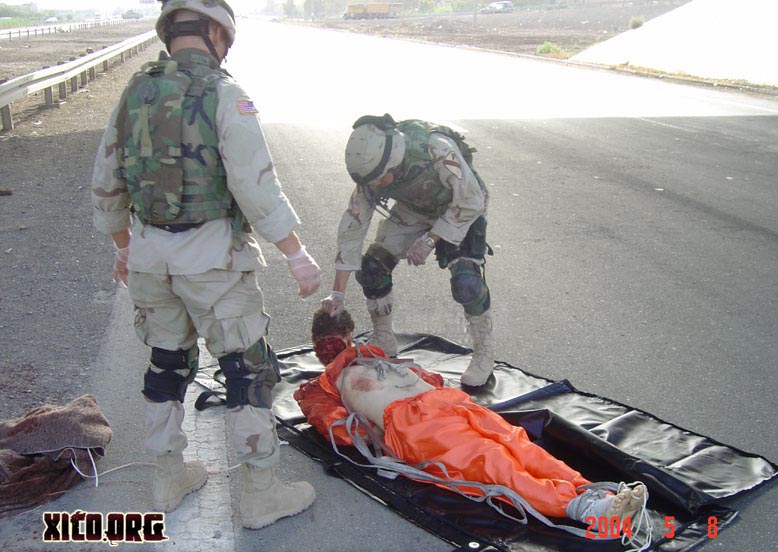
Berg's body was found decapitated on May 8, 2004 on a Baghdad overpass by a U.S. military patrol. Berg's family was informed of his death on May 10. Military sources stated publicly at that time that Berg's body showed "signs of trauma", but did not disclose that he had been decapitated.

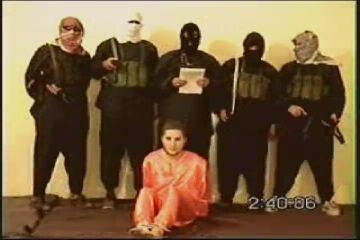
On May 11, 2004, the website of the militant Islamist group Muntada al-Ansar[5] posted a video with the opening title of "Abu Musa'b al-Zarqawi slaughters an American", which shows Berg being decapitated. Al-Zarqawi had an association with the Al-Qaida movement as does Muntada al-Ansar. The video is about five and a half minutes long.

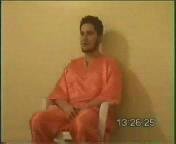
Berg is seen in the video wearing an orange jumpsuit. He identified himself: "My name is Nick Berg, my father's name is Michael, my mother's name is Susan. I have a brother and sister, David and Sarah. I live in West Chester, Pennsylvania, near Philadelphia."

The video shows Berg surrounded by five men wearing ski masks and head scarves. A lengthy statement is read aloud. The statement says that Berg's killing was in direct retaliation for the abuse of prisoners by U.S. troops at Abu Ghraib prison. The masked men then converge on Berg and decapitate him with a knife. A scream can be heard as men shout "Allahu Akbar."

On May 13, news outlets quoted a CIA source, speaking on the condition of anonymity, that a voice analysis of the tape has led the agency to conclude that the masked man who reads the statement and carries out the killing is "with high probability" Abu Musab al-Zarqawi.


Nick Berg, in orange, seated, before his decapitation by the five men standing over him.During the video, the man reading the statement threatens further deaths: "We tell you that the dignity of the Muslim men and women in Abu Ghraib and others is not redeemed except by blood and souls. You will not receive anything from us but coffins after coffins ... slaughtered in this way." The video further threatens U.S. President George W. Bush and Pakistani President Pervez Musharraf.

The video bears some similarities to the videotape showing the murder and decapitation of Wall Street Journal reporter Daniel Pearl in Pakistan in 2002. Like Pearl, Berg was Jewish, although it is uncertain whether his captors were aware of that. There are many differences noted with other decapitation videos, including the decapitation video of Paul Johnson in Saudi Arabia and the video of Kim Sun-il in Iraq.

Haiti violence


01 December 2006

Louis-François, Baron Lejeune captivity

Usted!’ (Surrender, surrender!) My horse, which was very strong, was the last to fall. He had already been hit some thirty times, and at last, covered with wounds, and no longer able to feel the spur, he rolled over dead amongst his comrades. I managed to struggle out of the crowd of fallen horses and men, and had defended myself for a short time with my sword, when I received a blow from a spear which was quite enough to kill me, but it only cut open my right hand, causing me such terrible pain as to paralyse my sword arm. My weapon fell, I was disarmed, and my assailants, athirst for blood and plunder, flung themselves upon me and began to tear off my clothes. In four seconds I was stripped naked from head to foot, but I was fortunately unwounded except for a few cuts from spears. Those of the brigands who were not too much encumbered with the spoil they had taken from me, now raised their muskets above the shoulders of their comrades and pointed them at my breast. I made no effort to shield it, but rather exposed myself as much as possible, my only hope being that I might die at the first discharge, and not have to endure a lingering anguish. But, strange to say, though seven or eight primings flashed, the charges did not go off! In their rage at having missed me, four of the brigands, threatening to have done with me in a moment, took fresh cartridges from their belts, and having loaded again they pointed their weapons at my breast, which I once more presented to them without flinching. But the primings hung fire again! Recognising the divine protection in this extraordinary incident, I seized with both hands one of the muskets which were being banged about my head, and with it parried the blows which would otherwise have killed me, for they bent out of shape the weapon which protected me. The terrible struggle sent a rush of blood to my heart, my strength failed me, and I was on the point of succumbing, when a man on horseback,

30 November 2006

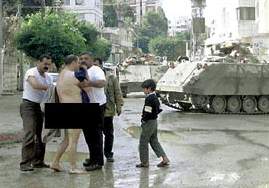
Palestinian stripped naked by Israelis


Stripping Palestinians has Become Common Practice: Eyewitness Accounts
By Suzanne Russ
November 27, 2002

OCCUPIED JERUSALEM (PC) - On Monday, November 25, Israeli soldiers ordered a young resident of the town of Nablus to strip completely naked in the street, according to Palestinian witnesses. Yasser Sharar, 25, was caught violating the curfew in Nablus and was stopped by Israeli soldiers at gunpoint, who immediately ordered him to remove his clothes.


In an interview with Reuters, a witness explained, “They forced Yasser to take off all his clothes including his underwear…they ordered him to walk like a dog and then he burst into tears,” The eyewitness who watched the scene from a few meters away continued, “He kept crying and was in a very stressful situation…many residents, including women watched him and he was very embarrassed.” Israeli soldiers refuted the claim, saying that they merely asked him to lift his shirt, but he voluntarily removed all his clothing to get media attention. The Reuters report also claimed that this is the first time Israeli soldiers have ordered Palestinians to completely strip naked publicly in a security operation. However, recent interviews conducted by the Palestine Chronicle with scores of residents of the Jenin refugee camp contradicted the Reuters claim. Dozens of residents of the refugee camp claimed that during the Israeli invasion of April, 2002, it was a common practice to force residents to strip naked as a form of humiliation, or as the Israelis say, a “security operation.” Na’el Ammar, 43, is a resident of the Jenin refugee camp and explains how Israeli soldiers arrested and detained scores of men from the refugee camp, and forced many to strip naked, “ We were mostly older people, sick and wounded. We had nine handicapped people with us, three were from the same family, sons of Abu Ibrahim. Some of us were too old, they were senile. When they told them “go left” they would go right, but they stripped them naked anyway. I tried to help them as much as I could. I was the only one who spoke Hebrew…Close to us was a group of young men. They were handcuffed, naked and lying on their stomachs. The Israeli tanks would pass by them so fast, only forty centimeters away from their heads.” Nawal Hawashin, a mother of eight, told Palestine Chronicle reporters that they threatened her 18 year old son with death if he did not follow their orders to strip naked, “They ordered my son and other young men to take off all their clothes and throw them on the ground. The soldiers warned that if the boys made any move, they would be shot. Near the Sahah, there was a body of a man with a white beard. He was lying dead on the ground, and tanks were rolling right over him. I couldn’t recognize him. My son Mohammed said, “Mother, I am too ashamed to take my clothes off in front of women.” I told him, ‘Son, this is our fate.” Jamal Hussein has a family of thirteen. A man who worked as a cheap laborer in Israel before the invasion of Jenin described in detail how terrified Jenin residents were gathered in the center of the camp and forced to undress, “Soldiers stationed on the top of a nearby house started throwing dirt on us.. We remained 15 men and boys. Half an hour later a tank came and stood near us. They pointed the canon at us. And they spent over an hour terrifying us that way. The commander of that unit spoke in Arabic to us, “Go to Saha”. While we were on our way, we kept reading Koran. We felt that they were going to execute us. Once we arrived there, we found a large number of men, forced to strip completely naked. There was a big pile of clothes. Soldiers started shooting right above our heads, they would call on us, one by one. Once they pointed at you, you would have to pull your pants down and your shirt up, when it was my turn, as I stood up, I noticed the body of a man, Jamal Sabbagh. It was some sort of a test. If you pass, you are arrested and if you don’t, they’ll shoot and kill you.” According to Jenin residents, Israeli forces were not discriminatory in their aggression, young men, old and disabled were targeted. 45-year old Um Siri lamented how her son was not only forced to strip naked, but how he was later used as a human shield, “Then they took my son, they had him strip naked, and they also started firing between his legs to terrorize him.” Israeli soldiers arrested and detained Um Siri’s son for days, during this time, she did not know if he was dead or alive. Finally she found him in a rescue shelter where he recounted how he was treated, “When I also found my son, he told me that the soldiers took him to a field near the camp with many other young men, he told me that the soldiers had them walk in front of the tanks, as they were looking for fighters.” The vulnerable and elderly, according to residents, were treated just as mercilessly. Um Siri recounted how the women of Jenin tried to come to the aid of some men, forced to stand naked publicly, in the pouring rain, “We passed by the sons of Sheikh Abdel Salam. They were standing there in the rain, after the Israelis had them strip completely naked. There was a woman who came with us. She took her headscarf and tore it to several pieces and gave it to the young men to cover themselves. A very thin old man approached while screaming, ‘My sons, my money, for God’s sake, they took everything!’ The Israelis had him strip naked like the day he was born. Once the women saw that, they started pulling their hair, hitting their heads, and wailing. He has all of his life’s savings with him, because he was worried that he might lose it in the invasion, but when the Israelis stripped him naked, they found the money and took it.” Other residents described how young men were stripped naked and then shot. Yusuf Shalabi, a young man from the camp explained how the Israeli soldiers denied medical treatment to the wounded, “…I remember this nightmare very well. It is very difficult to talk about it. I remember them stripping the people naked, they would handcuff them and blindfold them. I remember seeing two wounded men, one was wounded in the shoulder and the other in the leg. They were screaming in pain and the soldiers would not allow them to be treated. The Israeli army, who according to Amnesty International committed war crimes in Jenin in April of 2002, targeted medical workers as well. They also forced the women to remove their head scarves. Seham Shalabi, a young woman who works in a textile factory in Jenin recounted her memories of those days last April, “An army jeep came and started circling the house, then it opened fire at us. Why would they open fire at us? Then they came and they searched us, and had us walk two by two, out of the camp. Just as we began moving, we saw another group of tanks and bulldozers. We found some doctors and medical workers, forced strip naked, handcuffed. Then they put them in trucks and took them to the Salem detention center. The Israelis started shouting and ordering us to take off our head scarves. Humiliation of medial workers was not only reported by the residents of Jenin, but these events were also narrated by the medical workers themselves. Mohammed Rafi’ the director of the Red Crescent Society’s youth development programs in Jenin recounted how the Israelis held medical workers hostage in the Jenin hospital for days, and then forced them to strip naked as well. “They did not allow anyone in or out. If one of us wanted to leave to the hospital across the street, it would take two hours of telephone calls and deliberation. Ambulance drivers would be forced to wait for two hours with people bleeding inside before they were allowed entry to the hospital, they would take our volunteers or drivers, have them stripped naked, and interrogated and insulted. Of the scores upon scores of interviews conducted by Palestine Chronicle reporters in the Jenin refugee camp, that act of forcing civilians to strip naked was reported time and again. The Israeli army has defended the action, saying that such tactics are necessary to assure that Palestinians are not carrying explosives.

Vietnam Pow's story

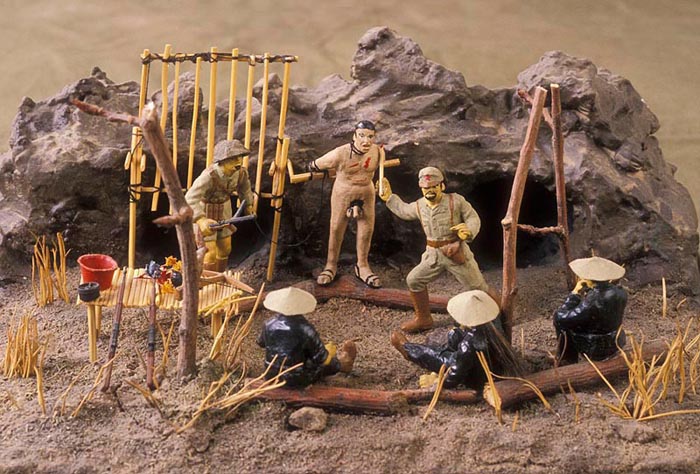
Don’t Forget Us, the POWs — Don’t Forget Us, the POWs is a very special scene, because I made it after I received an anonymous phone call at home after some of my stuff was shown on a local television program, shortly after I got started. Some vet in our area called me to say I was not talking about POWs or MIAs and went on for an hour and a half to describe some of his experiences. Being a prisoner of war is no picnic. You’re tortured daily, you’re beaten daily. They drag you through a village, from village to village, and try to break your morale, try to go against what you believe in, try to show you that you are wrong, killing kids and women, things like that. As the survivors of a Viet Cong ambush, these two men were subjected to inhuman treatment. They were beaten, stripped naked, and paraded through the streets of North Vietnam. The idea was to strip the soldier of his morale, leaving him with guilt. This treatment either strengthened him or broke him. Vets experience great psychological anguish when attempting to describe such experiences because we feel deeply for each other.
More stories at:
http://www.nyfolklore.org/pubs/voic30-3-4/warstr.html

22 November 2006

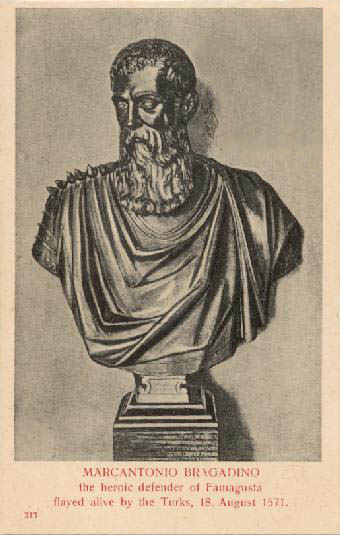
Marcantonio Bragadino Venetian commander


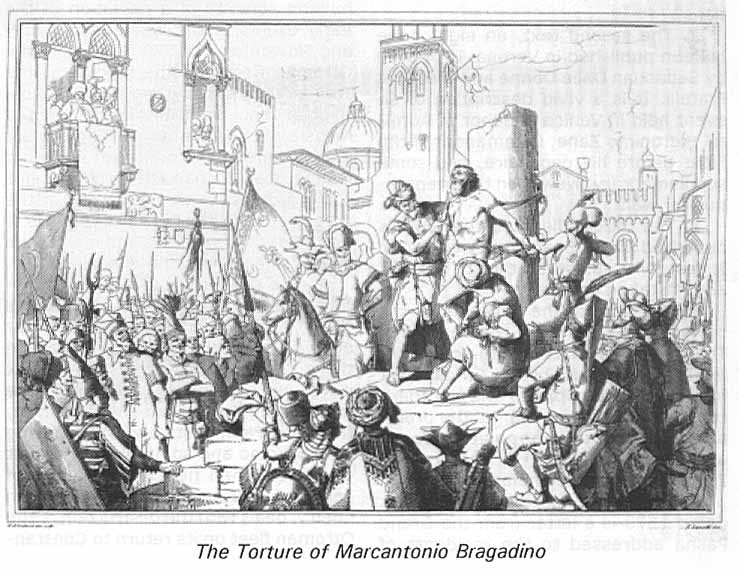
Marcantonio Bragadino who surrendered to theTurks was given very special treatment - it began with the slicing off of his nose and ears. He was whipped daily, given hard and humiliating labour , forced to kiss the earthunder the Turkish general's feet. His teeth were broken and then in Famagusta's central square - flayed alive. His voice , reciting the misere mei Deus ,gradually weakened. He was dead by the time his executioners knives reached his groin. His skin was stuffed with straw , hung from the mast of Mustapha'sflagship and passed in triumph along the Cypriot coast.


Marcantonio Bragadino- Venetian commander <1569-1602>

The admiral Marcantonio Bragadino was a remarkable Venetian commander who defended Famagusta during the wars of XVIe century against the Turks. It was shown compétant and courageous but, at the end of several months of seat, it was obliged to go. The Turkish chief offered honourable conditions to him and Bragadino left the fortress to sign rendering, vêtu dress crimson of its load, accompanied by the officers by his staff and protected from the sun by a large red umbrella from ceremony. The pasha accepted it initially courteously. But suddenly, during the ceremony, Turkish rose of a jump, showed Bragadino of atrocities towards the prisoners and ordered that the Venetian officers are massacred on the spot.The fate of Bragadino, was worse still. With three recoveries, it was about to be decapitated and by refinements of cruelty, one ordered to the torturer to stop. Its nose and its ears were cut, its body was mutilated, and during 10 days it was, each morning, charged with ground baskets, led on the Turkish fortifications and to stop in front of the tent of the pasha where it was to kiss the ground. One hoisted it with the yard of a ship and one let it be balanced there during hours. It suffered all kinds of mocking remarks sadistic and degrading. Finally, it was led on the great place of the city, was stripped, connected with a pile and sharp sectional view in the presence of the pasha. Its skin was empaillée and walked in the streets on a cow, with its red umbrella above him signs derision of it. And when finally the pasha regained in triumph the Gold Horn, this macabre trophy was balanced with the bowsprit of the ship standard.The skin was preserved at the arsenal Turkish of Constantinople. Years later, the Venetian ones took it again, some say bought it and others stole it. One can see today below the bust of Bragadino a small stone ballot box where its yellowed and seamed skin rests, carefully folded, like a handkerchief in a drawer with linen.

Excerpt

October 7, 1571

Near the Gulf of Lepanto

The future author of Don Quixote, Miguel de Cervantes, served on one of the Christian galleys in what he called the greatest naval sea battle in history and the most important to that time for the safety of Europe. The Turks had been massing an enormous fleet for an invasion of Italy. The preparations began to be reported on many months in advance. It was the year 1571 when that fleet was gathered near a port in Greece, not far from the Gulf of Lepanto.For over a year, Pope Pius V had tried to alert the great powers of Europe to the coming menace. But England, France, and the regional powers of what later became Germany were preoccupied with the turmoil of the Reformation.Only Don Juan of Austria, the bastard son of the king of Spain, was stirred by the danger. Despite his youth, despite his modest standing, Don Juan sent out urgent appeals and eventually gathered a sturdy fleet, outfitted with new warfare technologies invented in the West and rapidly mass-produced by the fledgling ship-building and armament firms of what was later to be called “Western capitalism.” He gathered fleets from Venice and Genoa, from Spain, and from the Knights of Malta. In a deliberately preemptive strike, blessed by the pope, this small fleet set sail to catch the Turkish armada before it left the waters of Greece.The Venetians, on the left flank of the battle line, were especially passionate. Not long before, the Turks had so battered an island port maintained by Venetians (and others) that the Venetian commander, Marcantonio Bragadino appealed for a truce. The Turks promised him and his subjects safe passage — and then took him prisoner, beat him, cut off his nose and ears, put a collar on him, and made him crawl like a dog before the conquering army. In a little cage, he was hoisted up on the mast of the galley so that all in the fleet and on land could see him. Then he was brought down flayed mercilessly, his skin carefully stripped from his body as he died (the skin was later stuffed with straw and sent off to Constantinople as a trophy). Thousands of Venetians and others were slaughtered on the spot, or driven off in captivity for service on Turkish galleys or in Turkish harems.But other elements of the Christian fleets were also angry. For decades now, the Turks had used their near-supremacy in the Mediterranean to make constant raids on the Christian communities near to the sea, and hauled away young women and men for the harems, and stronger men for the galleys.Indeed, many of the galley slaves pulling the oars of the Turkish fleet sailing proudly and confidently into the Gulf of Lepanto were Christians captured in these and other ways. There they were starved, beaten, and living in their own waste, kept just strong enough to pull on the great oars, to which they were chained. Furiously, below decks, some of these galley slaves were struggling to break through their chains once the battle was joined. Finally some did, and rose up from below deck swinging their chains and causing mayhem among already embattled Muslim sailors.

Other source

As the Captain of the Venetian forces at the siege of Famagusta on Cyprus in 1571 Bragadin suffered one of the most brutal and painful deaths imaginable, during a period of history that turned out to be very significant in the relationships between the Christian states of the 'West' in Europe and the Islamic empire in the 'East'.

I'm currently reading a 1936 work by H.V. Morton called "In The Steps Of St. Paul", and he recounts the story of Bragadin's death thus:

When the Turks entered Famagusta, this gallant soldier was brought before the Turkish general, Lala Mustafa, who pretended to execute him. He was forced to bare his neck three times to the executioner's sword, which each time was slowly lowered. Eventually, at a sign from the Turk, his nose and ears were cut off. "Where is your Christ now?" asked the Pasha. "Why does He not come and help you?" Those who watched the scene have left accounts in which they tell with what dignity and in what proud silence the tortured man bore himself. For ten days he was forced to carry earth to the ramparts and to kiss the ground each time that he passed the Pasha's tent. Then he was hoisted in a slung seat, with a crown tied at his feet, to the yard-arm of the flagship, and thus exposed to the jeers of the Turkish forces. At the end of ten days Bragadino was led with drums and trumpets to the great square of Famagusta, stripped, tied to a pillar, and slowly flayed alive ... Bragadino's skin, stuffed with straw, was tied to a cow and, with a red umbrella held over it in mockery, was paraded through the town. The tortured body was cut up like meat and portions hung on the gates of Famagusta. When the Turks sailed for Constantinople they tied the stuffed skin of Bragadino to the yard-arm and paraded it round the ports of the Mediterranean.

My sources dispute what happened next. Alberto Toso Fei's "Venetian Legends and Ghost Stories" book claims that the skin was captured from the armoury in Constantinople where it was on display as a war trophy. H.V. Morton claims that it was sold back to Bragadin's sons at a price. Either way the skin of the Ventian captain now resides in an urn set into a marble tribute to him, which features a head-and-shoulders bust of Bragadin and a sculpted relief of his death scene.

Fei's book quotes chronicles of the time describing the skin when it arrived in Venice:

It was folded in the width of a sheet of paper, solid and palpable as if it were a small cloth; you could still see the hairs of the chest attached to it, and on the right hand which had been skinned the unfinished fingers with the nails which still seemed alive...

21 November 2006

ABU GHARIB


Another image shows that the man, an Iraqi prisoner, is naked. His hands are clasped behind his neck and he is leaning against the door to a cell, contorted with terror, as the dogs bark a few feet away.

Other photographs show the dogs straining at their leashes and snarling at the prisoner.

In another, taken a few minutes later, the Iraqi is lying on the ground, withering in pain, with a soldier sitting on top of him, knee pressed to his back.

Blood is streaming from the inmate’s leg.

Another photograph is a closeup of the naked prisoner, from his waist to his ankles, lying on the floor.

On his right thigh is what appears to be a bite or a deep scratch.

There is another, larger wound on his left leg, covered in blood.”

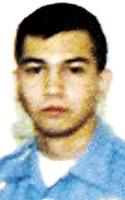
Sgt. Fernando Padilla-Ramirez

Fernando Padilla-Ramirez
Age 26. Married, 2 children. Killed in action: Mar. 28, 2003

As Marine Sgt. Fernando Padilla-Ramirez slogged across southern Iraq chasing the lead elements of the American invasion force, he dreamed of only one thing: He wanted to be a cop. The Yuma, Ariz. native had already secured a spot at the police academy. He even told them to "hold a motorcycle" for him. Fernando had grown up a block away from the local police station in Yuma and, at age 14, joined the youth Police Explorer program. By late March, coalition forces had raced across the Mesopotamian deserts to within 50 miles of Baghdad. Some units had moved so fast that they outran their supply trains. In the face of insurgent attacks and blinding sandstorms, Fernando's unit was charged with speeding supplies northward. But the would be cop and father of two children was destined for a last, ill-fated caper.

On March 28, Fernando had been last seen conducting convoy operations near the killing fields of Nasiriyah. Then he simply vanished. He was listed as missing in action. On the thirteenth day, they found his lifeless body. This time, the "perps" had won - and a silent motorcycle in the Arizona desert would forever remain without its rightful rider.


Marine Sgt. Fernando Padilla-Ramirez26, of Yuma, Ariz.; assigned to Marine Wing Support Squadron-371, Marine Wing Support Group-37, Marine Corps Air Station, Yuma, Ariz.; went missing while conducting convoy operations near Nasiriyah, Iraq. His remains were identified April 10.


Missing Ariz. Marine last seen in convoy

Military officials notify Sgt. Padilla-Ramirez's family Saturday of his disappearance near an Iraqi town.
The Associated PressMarch 31, 2003PHOENIX

A Marine from San Luis who was last seen conducting convoy operations near Nasiriyah was listed as missing yesterday by the Department of Defense.Relatives of Sgt. Fernando Padilla-Ramirez, 26, were notified by the military of his status Saturday and were waiting anxiously for more information, said his mother, Lorenza R. Padilla."We're very sad," she said from her home in San Luis, her voice trembling during a phone conversation. "We're thinking the worst."Padilla-Ramirez is assigned to Marine Wing Support Squadron 371 at Marine Corps Air Station Yuma. He was last seen Friday, according to a Defense Department release.No other information was immediately available. Officials at the Yuma air station didn't immediately return phone calls seeking comment yesterday to The Associated Press.Padilla-Ramirez was deployed about a month ago, leaving about five days after the birth of his second son, said Padilla. He also has a 5-year-old boy, she said.Padilla said she hasn't spoken to her son since he left but has received news about him through her daughter-in-law.The mother said her son was born in San Luis Rio Colorado, Mexico, across the border from San Luis. He was naturalized about two years ago, she said.She said he joined the Marines as a teenager, served for four years and then signed up for another three. He is in the last year of his military commitment, Padilla said.Padilla-Ramirez is one of two Arizona residents listed among those missing in Iraq. The other, Pfc. Lori Piestewa of Tuba City, is a member of the Army's 507th Maintenance Company, which was attacked by Iraqi soldiers March 23


US marine executed and his corpse displayed in Public

US Marines moved into the southern Iraqi town of Shatrah today to recover the body of a dead comrade which had been hanged in the town square, officers said.
Hundreds of troops were dispatched on the operation after intelligence reports indicated the body of a dead American, who was killed in a firefight last week, had been paraded through the streets and hanged in public.
"We would like to retrieve the body of the marine but it is not our sole purpose," said Lieutenant-Colonel Pete Owen, of the First Marine Expeditionary Force.
Military sources said another part of the operation was to arm local militias to fight against members of the ruling Baath party loyal to Iraqi President Saddam Hussein.
Shatrah is some 40 km north of Nasiriyah, where Iraqi forces have been harassing US supply lines and putting up tough resistance for more than a week

Dead US soldier hung on public display

Eversince I've read about the US Marine who was captured and executed, dragged and later displayed in public in Iraq, I check out the entire web for follow up news, but it's futile. After 3 years once I again I search for it and found.

Based on the news the marine was part of an air-wing support squadron making its way north late at night when it was hit by rocket-propelled grenades and machine-gun fire. The date of his captured is March 28,2003. Ive search all the casualties in Iraq during that day and found out that 3 marines died that day. I dismiss the posibilities of the other two marines. Sgt.Padilla is included in the convoy operations in the vicinity in Nasiriya.

Below was the circulating news that time:

Marines search for fallen comrade
US Marines moved into the southern Iraqi town of Shatrah today to recover the body of a dead comrade which had been hanged in the town square, officers said.

The Associated Press:
From correspondents in southern
IraqApril 01, 2003

US Marines moved into the southern Iraqi town of Shatrah today to recover the body of a dead comrade which had been hanged in the town square, officers said.Hundreds of troops were dispatched on the operation after intelligence reports indicated the body of a dead American, who was killed in a firefight last week, had been paraded through the streets and hanged in public.

Marine officers dispatched a helicopter to investigate a report that the body of a missing Marine had been publicly displayed in the center of Ash Shatrah, north of Nasiriyah. The Marine has been missing since the 7-ton truck he was riding in went off the road yesterday during an attack on its convoy


The Marine was captured Friday during an attack on a 200-vehicle convoy that was passing through Shatrah on Route 7, on its way north.


Sgt. Fernando Padilla-Ramirez


Marine Wing Support Squadron-371,

Marine Wing Support Group-37,

Marine Corps Air Station
Yuma, Arizona

Marine Sgt. Fernando Padilla-Ramirez was born in San Luis Rio Colorado, Mexico, and was naturalized as a U.S. citizen in 2001. He joined the Marines as a teenager, serving for four years and then signing up for another three. Padilla-Ramirez was killed in combat March 28. He has a 5-year-old son; a second son was born just five days after he shipped out to Iraq.
He was last seen conducting convoy operations in the vicinity of Al Nasiriyah on 28 March. A search and rescue effort is continuing. March 31, 2003


DOD ANNOUNCES CHANGE IN MARINE CASUALTY STATUS The Department of Defense announced today it has changed the status of Marine Sgt. Fernando Padilla-Ramirez from Duty Status Whereabouts Unknown (DUSTWUN) to killed in action. Sgt. Padilla-Ramirez, 26, of San Luis, Ariz., was assigned to Marine Wing Support Squadron-371, Marine Wing Support Group-37, Marine Corps Air Station, Yuma, Ariz. He was last seen conducting convoy operations in the vicinity of Al Nasiriyah on 28 March. His remains were identified on April 10.